Landlord Credit Reports: A Complete Guide for 2026
March 2nd, 2026 by Dodie
Selecting a new tenant represents a significant decision, one where financial stability and personal reliability are paramount. Yet, the process is often fraught with uncertainty, from navigating the complexities of the Fair Credit Reporting Act (FCRA) to accurately interpreting dense financial data. A meticulously executed screening process, centered on the proper use of landlord credit reports, is your most effective tool for mitigating these risks. It provides a clear, objective window into an applicant’s financial history, but only when obtained and utilized in full compliance with federal and state regulations. The challenge lies not just in accessing this data, but in understanding its implications and acting upon it lawfully.
This comprehensive guide for 2026 is designed to eliminate that uncertainty. We will provide a clear, step-by-step framework for obtaining, interpreting, and legally using tenant credit reports to protect your investment. You will learn to identify critical financial red flags, understand your compliance obligations to avoid costly litigation, and establish a consistent screening protocol. By the end, you will be empowered to streamline your selection process and confidently choose reliable, financially responsible tenants who will safeguard your property and your peace of mind.
Key Takeaways
- Understand how to interpret a tenant’s complete financial history to accurately predict payment behavior and mitigate investment risk.
- Develop a consistent, written evaluation criteria to analyze credit data fairly, ensuring you assess the full picture beyond just the score.
- Navigate the complexities of the Fair Credit Reporting Act (FCRA) to ensure your tenant screening process is fully compliant and protected from litigation.
- Discover the most secure and efficient methods for obtaining landlord credit reports, including the key benefits of tenant-initiated checks for data privacy.
Understanding the Landlord Credit Report: Your First Line of Defense
A tenant credit report is far more than a simple number; it is a detailed summary of an applicant’s financial history and their record of meeting financial obligations. For Lago Vista landlords, understanding these landlord credit reports is a foundational step in mitigating risk. This document serves as a critical predictive tool, offering verified insights into an applicant’s potential payment behavior and empowering you to make informed, data-driven leasing decisions that protect your investment.
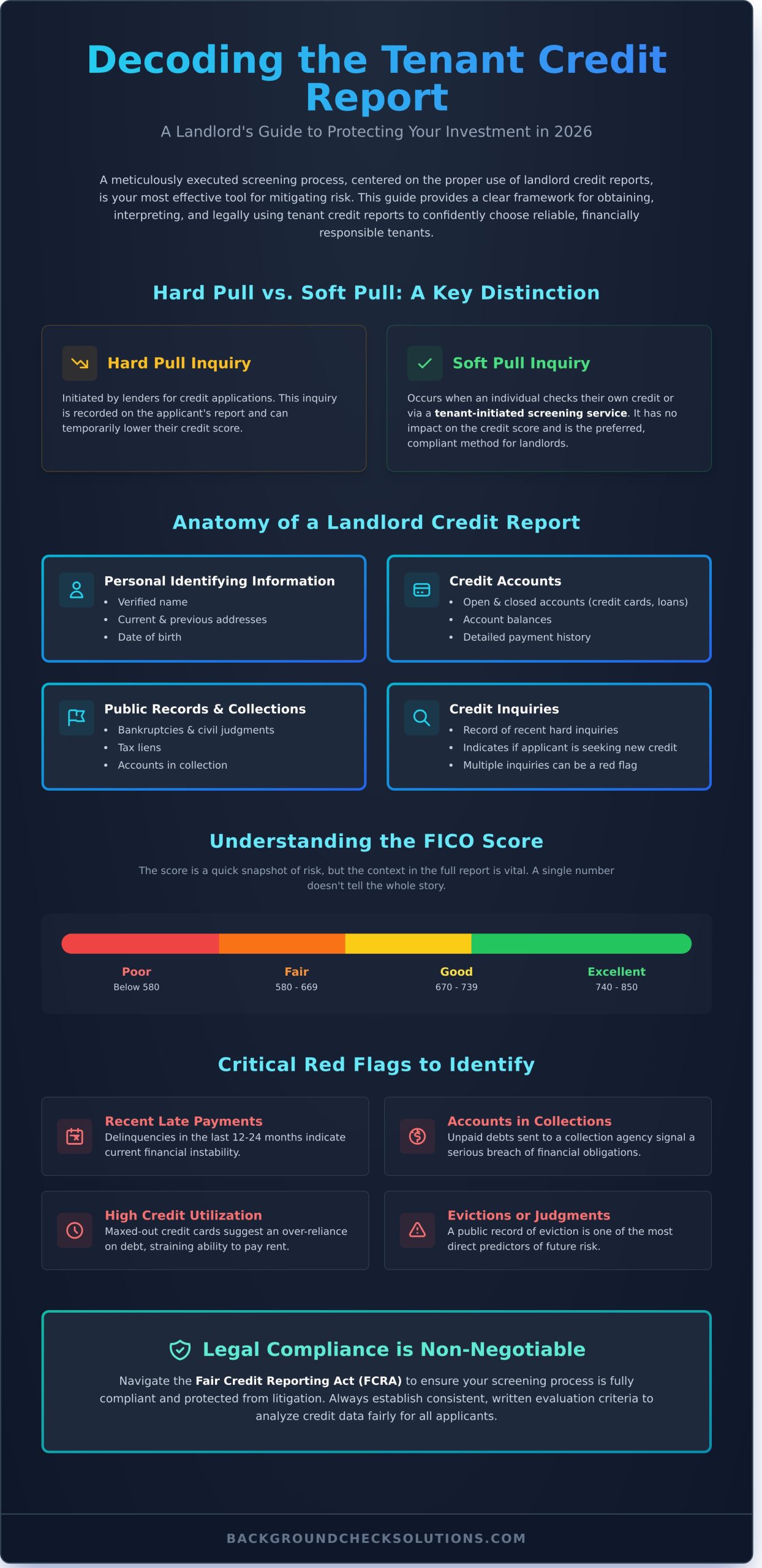
A key distinction in the screening process is between a ‘hard pull’ and a ‘soft pull’ inquiry. A hard pull, typically initiated by a lender for a credit application, is recorded on the applicant’s report and can temporarily lower their score. In contrast, a soft pull, which occurs when an individual checks their own credit or a landlord uses a tenant-initiated screening service, has no impact on the credit score. This tenant-initiated model is the preferred, compliant method, as it protects the applicant’s credit while providing you with the necessary data from the three major credit bureaus: Experian, Equifax, and TransUnion.
What Information Does a Tenant Credit Report Contain?
This comprehensive report provides a multi-faceted view of an applicant’s financial standing. Key components include:
- Personal Identifying Information: Verified name, current and previous addresses, and date of birth.
- Credit Accounts: A detailed list of open and closed accounts, such as credit cards, auto loans, and mortgages, including balances and payment history.
- Public Records & Collections: Information on bankruptcies, civil judgments, liens, and any accounts that have been sent to collection agencies.
- Credit Inquiries: A record of recent hard inquiries from other lenders or landlords, which can indicate if an applicant is seeking multiple lines of credit simultaneously.
The FICO Score: What Landlords Need to Know
The FICO score is a standardized, three-digit number that provides a snapshot of an applicant’s credit risk. This numerical representation, often referred to as a credit score, is calculated from the data in the report. While ranges vary, they generally fall into categories such as Excellent (800+), Good (670-739), Fair (580-669), and Poor (below 580). However, it is crucial to remember that the score alone does not provide a complete picture. A thorough review of the full report is essential, as the context behind the number-such as consistent late payments versus a single past medical collection-is vital for an accurate risk assessment.
How to Analyze a Credit Report: Reading Between the Lines
A three-digit credit score provides a convenient summary, but for landlord credit reports, the most critical insights are found within the detailed data. A comprehensive analysis moves beyond the score to identify patterns of financial responsibility. To ensure fairness and mitigate legal risk, it is imperative for Lago Vista landlords to establish consistent, written criteria for evaluating all applicants. This practice not only streamlines your decision-making but also ensures your process is compliant with regulations like the Fair Credit Reporting Act (FCRA).
The primary goal is to assess an applicant’s history of meeting financial obligations, as this is the strongest predictor of their ability to pay rent consistently and on time.
Key Red Flags for Landlords
While a single misstep may not be disqualifying, a pattern of financial distress warrants careful consideration. The most significant red flags to identify include:
- Recent Late Payments: Delinquencies within the last 12-24 months, especially on rent or utility accounts, can indicate current financial instability.
- Accounts in Collections or Charge-Offs: Unpaid debts sent to a collection agency or written off by a creditor signal a serious breach of financial obligations.
- High Credit Utilization: Maxed-out credit cards suggest an over-reliance on debt, which can strain an applicant’s ability to cover new monthly expenses like rent.
- Evictions or Judgments: A public record of a previous eviction or a monetary judgment from a former landlord is one of the most direct predictors of future risk.
Understanding Positive and Neutral Indicators
Conversely, a credit report can present strong positive signals. A long history of consistent, on-time payments across multiple accounts is the most reliable indicator of a responsible tenant. Do not immediately dismiss an applicant with a limited credit history, or a “thin file.” This is common for younger applicants and may simply require supplementary verification, such as proof of income and rental history. Furthermore, it is prudent to view medical debt differently than consumer debt, as it often arises from unforeseen circumstances rather than poor financial management.
Debt-to-Income Ratio (DTI): A Critical Calculation
The Debt-to-Income (DTI) ratio is an objective measure of an applicant’s capacity to manage their monthly rent payment alongside existing debts. To estimate DTI, divide the applicant’s total monthly debt payments (found on the credit report) by their gross monthly income (verified through pay stubs). While there is no universal standard, many landlords prefer a DTI ratio below 43%, including the proposed rent. This calculation provides a clear, data-driven assessment of affordability, ensuring the applicant is not overextended.
Legal Compliance: Navigating the Fair Credit Reporting Act (FCRA)
When utilizing landlord credit reports to evaluate potential tenants, understanding your legal obligations is not optional-it is paramount. The entire process is governed by the Fair Credit Reporting Act (FCRA), a federal law designed to ensure the accuracy, fairness, and privacy of the information in consumer reporting agency files. While it is essential to understand what a credit report is and the data it contains, it is equally critical to manage that data in strict accordance with legal standards. Non-compliance can lead to severe penalties, including substantial fines and costly litigation. To mitigate this risk, maintain meticulous records of your screening criteria and process for every applicant, ensuring a consistent and defensible procedure.
The complexity of landlord-tenant law underscores the importance of clear legal guidance, a need that is universal. For example, English-speaking individuals navigating the legal system in other countries, like Israel, often require specialized support; those in such a situation can visit SALIOR Law Office for assistance.
Step 1: Obtain Proper Written Consent
Before you can run a credit check on a prospective tenant, you are legally required to obtain their explicit written permission. This consent must be provided in a clear and conspicuous disclosure document, separate from the lease agreement itself, though it is often included as a distinct section within the rental application. Ensure this authorization form is signed and dated by the applicant before you initiate any background screening, as this document is your legal basis for accessing their private financial information.
Step 2: Use a Reputable, FCRA-Compliant Screening Service
Partnering with a professional, FCRA-compliant screening provider is a critical component of risk management. These specialized services are structured to navigate the complexities of federal and state regulations, ensuring that all data is sourced, handled, and delivered in a legally sound manner. Attempting to source this information independently exposes you to significant compliance vulnerabilities. Our pay-per-report service ensures full FCRA compliance, providing you with verified data and the peace of mind that comes from a secure, professional process.
Step 3: Follow the Adverse Action Process
If information from the landlord credit reports leads you to take any “adverse action”-such as denying the application, requiring a co-signer, or charging a higher security deposit-you must follow a strict, two-step notification procedure mandated by the FCRA.
- Pre-Adverse Action Notice: You must first provide the applicant with a notice of the potential adverse action. This communication must include a copy of the credit report you used and a copy of “A Summary of Your Rights Under the Fair Credit Reporting Act.” This gives the applicant an opportunity to review the information and dispute any inaccuracies with the credit reporting agency.
- Final Adverse Action Notice: After allowing a reasonable period for the applicant to respond (typically five business days), you can send the final notice. This letter formally states the adverse action taken, provides the name and contact information of the screening company that furnished the report, and reiterates the applicant’s right to dispute the report’s accuracy.
How to Run a Credit Check on a Prospective Tenant
Executing a credit check is a critical, non-negotiable step in mitigating risk and securing your investment. The process can be initiated in two primary ways: the traditional landlord-initiated request or the modern, more secure tenant-initiated report. We strongly advocate for the latter, as it places the applicant in control of their sensitive data, significantly reducing your liability. To streamline this procedure, it is essential to integrate the credit check as a standard component of your tenant screening protocol and to establish a clear application fee upfront to cover the associated costs.
Choosing a Tenant Screening Service
Selecting a screening partner is a decision that directly impacts the security of your property and the integrity of your tenant selection process. When evaluating providers for landlord credit reports, consider their service models:
- Subscription-Based: Best suited for property management firms handling a high volume of applications, offering a lower cost-per-report.
- Pay-Per-Use: Provides maximum flexibility for independent landlords, allowing you to pay only for the reports you need without a recurring commitment.
A thorough service should offer a comprehensive background check that extends beyond credit to include criminal records and eviction history, providing a holistic view of the applicant’s reliability.
The Information Required from Applicants
Modern, compliant screening platforms are designed to protect both the landlord and the applicant by removing you from the chain of custody for sensitive personal data. The applicant will be prompted to enter their information-typically their full name, date of birth, and Social Security Number (SSN)-directly into a secure, encrypted online portal. This method ensures data privacy and significantly mitigates your risk of a data breach. Entrusting this critical step to a verified provider is paramount to maintaining compliance and peace of mind. Partnering with a dedicated service like Background Check Solutions facilitates a secure and seamless experience.
Why Choose Background Check Solutions for Landlord Credit Reports
Selecting a tenant screening partner is a critical decision for protecting your Lago Vista rental property. In a complex regulatory environment, you need a partner whose process is built on a foundation of trust, accuracy, and legal integrity. At Background Check Solutions, we leverage over four decades of industry leadership-since 1982-to provide a screening process that is not only comprehensive but also meticulously compliant with all legal standards, mitigating your risk and streamlining your decisions.
We believe in transparent, straightforward service tailored to the needs of modern landlords. Our model is built on this principle:
- No Subscriptions or Hidden Fees: Utilize our services on a simple pay-per-report basis. This ensures you only pay for the screening you need, making it a cost-effective solution for landlords of any size.
- Ironclad FCRA Compliance: Our streamlined, applicant-driven process ensures full adherence to the Fair Credit Reporting Act. The system manages consent and delivery, simplifying your workflow and protecting you from potential litigation.
- Unmatched Experience: With a foundation dating back to 1982, our processes are refined by over 40 years of industry expertise, providing you with unparalleled reliability.
A More Complete Picture for Informed Decisions
A credit score alone offers an incomplete narrative. Our reports are designed to provide a more complete picture, combining the FICO® Score with a detailed payment history, public records, and collection accounts. This multi-faceted approach allows you to identify patterns of financial behavior that a single number cannot reveal, empowering you to assess an applicant’s reliability with greater accuracy. For a truly comprehensive evaluation, you can easily bundle credit data with our national criminal and eviction searches. All this information is presented in a clear, easy-to-read format, facilitating quick yet thorough analysis.
Get Started in Minutes with No Commitment
Your time is valuable. Our secure, intuitive platform is engineered for efficiency, allowing you to create an account and begin screening applicants in minutes. There are no complex setups or lengthy approval processes. Whether you manage a single-family home in Lago Vista or a portfolio of multi-unit properties, our system is scalable to your needs. By choosing Background Check Solutions, you are not just running a check; you are actively protecting your investment with reliable, verified data you can trust.
Make your next leasing decision with confidence. Explore our tailored solutions for landlord credit reports and secure your peace of mind by visiting backgroundchecksolutions.com today.
Protect Your Property with Informed Decision-Making
As we’ve explored, effectively utilizing a tenant’s credit report is a multi-faceted process. It requires not only a thorough understanding of the financial data presented but also a disciplined approach to analysis and, most critically, unwavering adherence to the Fair Credit Reporting Act (FCRA). Mastering these components transforms a simple document into a powerful tool for risk mitigation, safeguarding your rental property against potential financial losses and liabilities.
Navigating this complex landscape requires a partner committed to accuracy and compliance. Since 1982, Background Check Solutions has provided landlords with the precise tools needed for this critical task. Our comprehensive landlord credit reports are sourced from primary credit, criminal, and eviction databases, delivered through a convenient pay-per-report model with no sign-up fees. We streamline the process, allowing you to focus on selecting qualified, reliable tenants.
Take the next step in protecting your investment. Order a comprehensive, FCRA-compliant tenant credit report today.
Secure your peace of mind and build the foundation for a successful tenancy.
Frequently Asked Questions About Tenant Credit Reports
What is the minimum credit score a tenant should have?
While there is no legally mandated minimum credit score, a common benchmark for Lago Vista landlords is a score of 670 or higher. This figure typically indicates a history of responsible financial management. However, a comprehensive evaluation is critical. A lower score might be mitigated by factors such as a substantial income, a larger security deposit, or a qualified co-signer. Your rental criteria should be applied consistently to all applicants to ensure fair housing compliance.
Can a landlord run a credit check without the applicant’s permission?
No. Under the federal Fair Credit Reporting Act (FCRA), a landlord must obtain explicit, written consent from a prospective tenant before running a credit check. This permission is a fundamental component of the rental application process. Proceeding without this authorization is a serious legal violation that can result in significant penalties. Ensure your application form includes a clear, standalone disclosure and authorization statement that the applicant must sign before you initiate any screening.
How long does it take to get a landlord credit report?
Modern, professional screening services have streamlined the process to deliver results with exceptional speed. In most cases, once an applicant submits their information and provides consent through a secure online portal, the landlord credit reports are generated and made available almost instantaneously. This rapid turnaround time allows you to make timely, informed decisions, reducing vacancy periods and securing qualified tenants efficiently without compromising on the thoroughness of the evaluation.
Does running a credit check for an apartment hurt the applicant’s credit score?
This depends on the type of inquiry used. Many tenant screening platforms utilize a “soft inquiry,” which is initiated by the applicant and does not affect their credit score. This is the preferred method. However, a “hard inquiry,” directly initiated by the landlord, can cause a minor, temporary dip in the applicant’s score. Clarifying which type of inquiry your service uses provides transparency to applicants and helps maintain a positive relationship from the start.
What is an ‘adverse action notice’ and when do I need to send one?
An adverse action is any negative decision made based on information in a consumer report. For landlords, this includes denying an application, requiring a co-signer, or charging a higher security deposit. If you take any such action based on the tenant’s credit report, the FCRA legally requires you to send an adverse action notice. This formal letter must inform the applicant of the decision, provide the contact information for the credit reporting agency used, and state their right to dispute the information.
Can I charge a tenant for the cost of a credit check?
Yes, it is standard practice for landlords to charge a non-refundable application fee that covers the cost of tenant screening, including the credit check. However, you must adhere to any applicable Texas state or local Lago Vista regulations regarding the amount and disclosure of such fees. It is crucial that the fee is a reasonable reflection of your actual screening expenses and is charged uniformly to every applicant to avoid any claims of discrimination.
What should I do if an applicant has no credit history?
A lack of credit history, often called a “thin file,” is not inherently a negative indicator and is common among young adults or recent immigrants. Instead of immediate denial, you should rely on alternative verification methods to assess their financial stability. Request documents such as recent pay stubs, bank statements showing consistent deposits, or letters of reference from previous landlords or employers. This demonstrates due diligence while expanding your pool of potential tenants. For more advanced strategies on evaluating non-traditional applicants, you can discover Allen & Allen, Inc. and their educational services.
How do I handle an applicant who disputes information on their credit report?
If an applicant disputes the accuracy of information found within landlord credit reports, you must handle the situation with procedural precision to ensure FCRA compliance. You should direct the applicant to the consumer reporting agency that furnished the report to formally initiate a dispute. It is advisable to pause the application review process until the dispute is resolved. Document all communications and maintain a consistent policy for handling such situations to mitigate potential litigation risk.
Comments are closed.