National Criminal Database Search: The Definitive Guide for 2026
March 25th, 2026 by Dodie
In a labor market where 8.2 million Americans relocate to a different state annually, relying solely on local records leaves your organization vulnerable to significant blind spots. You’ve likely felt the persistent anxiety that a standard background check might overlook a serious record filed just one county over. It’s a valid concern. The 2024 PBSA survey indicates that 76% of employers prioritize accuracy above all else, yet many remain frustrated by fragmented data and restrictive monthly subscription fees. This definitive guide to the national criminal database search will demonstrate how to leverage multi-jurisdictional data to mitigate risk and protect your assets effectively. We’ll explore the specific datasets included in these searches, explain how to maintain strict FCRA compliance, and show you how a pay-per-report model provides the precision you need without unnecessary overhead. You’ll finish this guide with the peace of mind required to secure your hiring process through a verified, primary-source strategy.
Key Takeaways
- Understand how a national criminal database search functions as a multi-jurisdictional screening tool to establish a secure foundation for your organization’s risk mitigation strategy.
- Examine the technical process of data aggregation to better manage the inherent lag time between local court convictions and national record availability.
- Determine when to prioritize the broad reach of a national search versus the granular depth of county records to ensure your screening protocols are both efficient and thorough.
- Mitigate legal exposure by mastering the mandatory FCRA compliance steps and adverse action procedures essential for modern landlords and employers.
- Discover how to leverage verified, primary-source data through a flexible pay-per-report model that eliminates the financial burden of traditional subscription fees.
What is a National Criminal Database Search?
A national criminal database search functions as a multi-jurisdictional “wide-net” screening tool. It serves as the primary foundation for modern risk management strategies in both employment and tenant screening. This tool doesn’t pull from a single, government-run repository; instead, it aggregates information from thousands of disparate sources to create a comprehensive profile. It’s the most effective way to identify potential red flags that exist outside an applicant’s current or previous residential history.
It’s a common misconception that a unified, federal database exists for private-sector background checks. In reality, the landscape of Criminal records in the United States is decentralized. There are over 3,000 counties and hundreds of state-level agencies that manage their own data independently. A national search bridges these gaps by compiling records into a searchable format, allowing Background Check Solutions to provide a broader safety net for our clients. This proactive approach ensures that a candidate’s history in a state they visited briefly doesn’t go unnoticed during the vetting process.
The primary goal of this search is to identify criminal activity across state lines where a standard local search might fail. Statistics from 2024 indicate that approximately 12% of criminal records are discovered in jurisdictions where the applicant never established a formal residence. Without this multi-jurisdictional layer, an employer might overlook a serious conviction simply because it occurred during a short-term relocation or travel. It’s an essential component for maintaining a secure and compliant workplace environment.
The Scope of Multi-Jurisdictional Data
This comprehensive scan includes records from the Department of Corrections (DOC), the Administrative Office of the Courts (AOC), and 50-state sex offender registries. While a county-level search provides deep, localized details, the national criminal database search offers breadth. It covers thousands of jurisdictions simultaneously, providing a high-level overview of an individual’s past. This differs significantly from a single-state search, which is limited by geographic borders and often misses relevant data from neighboring regions.
Speed is a defining characteristic of this tool, with many results appearing almost instantly. However, Background Check Solutions maintains a strict protocol for accuracy; we don’t rely solely on automated hits. If a record is flagged, our team initiates a manual verification process at the source to ensure the information is current and belongs to the correct individual. This step is vital for FCRA compliance and prevents the “false positives” that often plague lower-tier screening services.
Why Businesses Prioritize National Screening in 2026
By 2026, the traditional office model has shifted, and over 28% of the workforce now operates in a remote or hybrid capacity across state lines. High applicant mobility means that a localized search is no longer a sufficient standard for safety. Businesses now prioritize national screening to account for this geographic fluidity. It’s a protective measure that reflects the reality of a modern, mobile labor market where an applicant’s history is rarely confined to a single zip code.
Utilizing a broad search as an initial filter is also a highly cost-effective strategy. It allows hiring managers to quickly identify high-risk candidates before investing in more expensive, localized deep dives. This process fulfills the legal requirement for “due diligence,” which is critical for mitigating negligent hiring litigation. By integrating this wide-net tool, organizations demonstrate a commitment to thoroughness, protecting both their existing staff and their corporate reputation through meticulous data acquisition.
How Data Aggregation Works: Behind the Scenes of a Background Check
A national criminal database search functions as a massive digital net, pulling information from more than 8,000 municipal, county, and state jurisdictions across the United States. This process involves sophisticated data scraping technology that gathers millions of records, including department of corrections files, court records, and sex offender registries. While this sounds exhaustive, it’s a common misconception that this database is a single, live federal file. Instead, it’s a private aggregate maintained by third-party providers. Because these jurisdictions don’t all report in real-time, the data isn’t always current. Relying solely on an unverified aggregate can expose a company to significant legal vulnerabilities.
According to industry data from 2023, the lag time between a conviction at the local level and its appearance in a national aggregate often ranges from 30 to 90 days. This delay occurs because many small-town courts still rely on manual data entry or legacy systems that only export records to aggregators on a monthly or quarterly basis. If a candidate was convicted of a felony 45 days ago, an “instant” search might return a clean result. To mitigate this risk, Background Check Solutions treats database hits as “tips” rather than final evidence. We always perform primary source verification, which involves contacting the specific courthouse of record to confirm the disposition, date, and identity of the individual. This step ensures compliance with the Summary of Your Rights Under the Fair Credit Reporting Act, protecting both the employer and the applicant from the consequences of outdated or inaccurate information.
The Role of SSN Verification in Criminal Searches
Social Security Number (SSN) verification serves as the architectural foundation of a professional background check. Background Check Solutions uses SSN verification as a critical first step to identify a candidate’s 7-year or 10-year address history and any known aliases or maiden names. This trace doesn’t provide criminal records itself; instead, it creates a roadmap for where the national criminal database search should focus its efforts. If an applicant’s SSN reveals a previously undisclosed residence in a different state, it triggers a targeted search in that specific jurisdiction. This proactive approach ensures that no stone is left unturned, providing the peace of mind that comes from a truly comprehensive investigation. Organizations that skip this step often miss records filed under different names or in regions where the candidate lived only briefly.
Data Freshness and Accuracy Challenges
Data latency is the delay between record creation and database updates. This gap is the primary reason why low-quality vendors offering $19.99 “instant” reports are a liability for corporate HR departments. In 2022 alone, litigation related to inaccurate background checks cost U.S. employers millions in settlements. These errors often stem from “false positives,” where a common name like “John Smith” is incorrectly matched to a criminal record because the database lacked a middle name or birthdate for verification. Professional human oversight is required to match records precisely to the correct individual by cross-referencing multiple identifiers. Developing a tailored screening protocol ensures that your organization doesn’t fall victim to these common data pitfalls. Our analysts review every hit to ensure the information is reportable under current state and federal laws, maintaining the high standards of accuracy your security strategy demands.
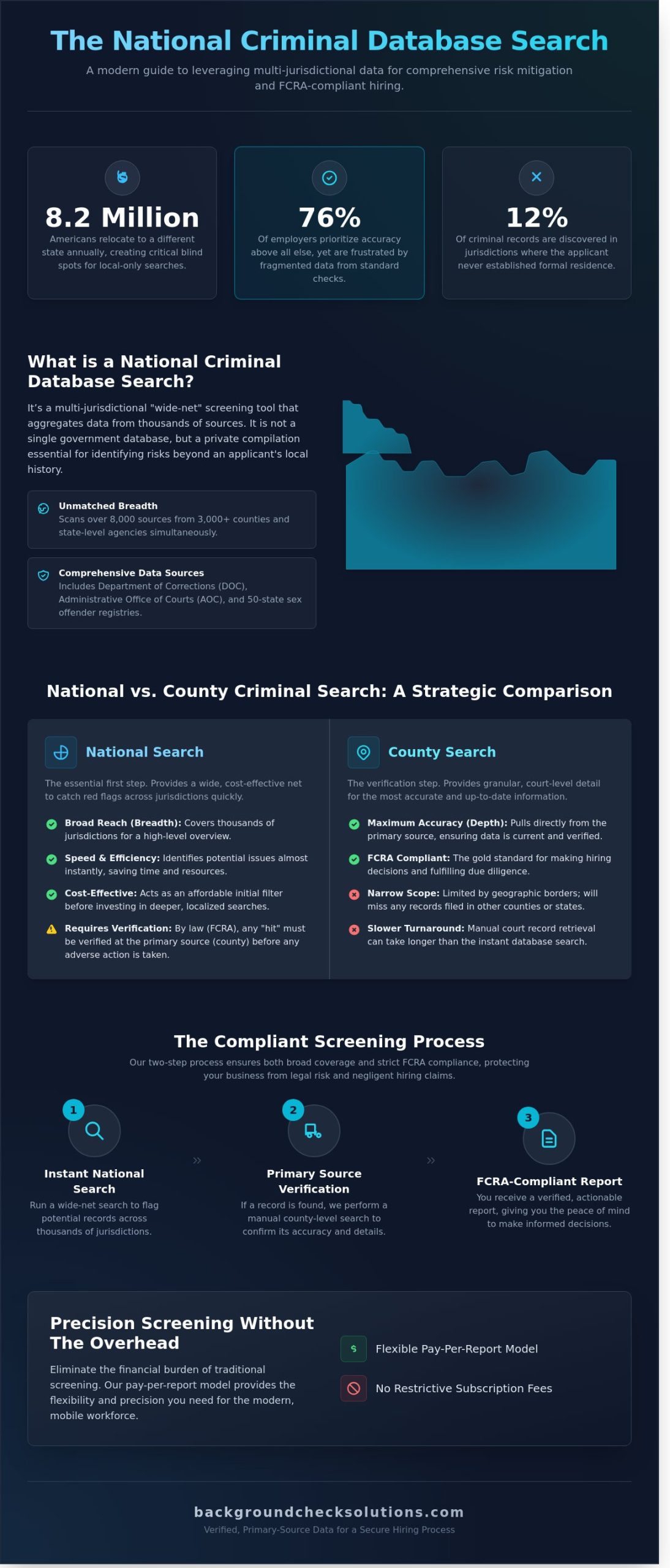
National Search vs. County Criminal Records: A Strategic Comparison
When the National Database is Your Best Tool
A national criminal database search excels at uncovering hidden records in states an applicant didn’t disclose on their resume. Candidates often omit locations where they committed crimes, but this multi-jurisdictional tool identifies those “off-grid” hits. It’s an indispensable resource for identifying registered sex offenders and individuals on global terrorist watchlists. For high-volume hiring in low-risk sectors, such as seasonal retail or entry-level hospitality, the speed of this search provides the necessary efficiency to onboard teams quickly without sacrificing basic safety protocols.
The Limitations of Aggregate Data
While broad, these databases aren’t exhaustive. Private aggregates rely on jurisdictions voluntarily reporting their data, which doesn’t happen in real-time. Some counties only update their digital records once a month; others might only report quarterly. This lag means a “no record found” result isn’t a 100% guarantee of a clean history. It’s also vital to distinguish these commercial tools from the FBI’s National Crime Information Center (NCIC), which is reserved for law enforcement use. Furthermore, crimes tried in U.S. District Courts, such as tax evasion or federal drug trafficking, won’t appear in standard county or state searches. They require a separate federal criminal search to ensure total compliance.
Professional screening firms advocate for a “Hybrid Approach” to mitigate these inherent gaps. This strategy uses the national search as a lead generator to flag potential issues. Once a “hit” occurs, the screening partner initiates a precise county-level search to verify the details at the source. This step is mandatory for high-security roles or executive positions where the cost of a bad hire is extreme. In 2023, data showed that relying solely on a national search could miss up to 30% of recent local filings because of reporting delays.
Using a 7-year or 10-year address history to trigger specific county searches ensures that you’re looking exactly where the candidate has lived, worked, or attended school. This methodical process provides the peace of mind that a simple database sweep cannot offer. It transforms the background check from a box-checking exercise into a robust risk mitigation strategy. By combining the speed of technology with the accuracy of primary-source verification, you create a protective barrier for your organization’s assets and reputation.
Navigating FCRA Compliance and Adverse Action
The Fair Credit Reporting Act (FCRA) established the legal framework for background screenings in 1970, and its requirements remain the cornerstone of modern hiring practices. Any organization utilizing a national criminal database search must operate within these parameters to avoid costly litigation. A standard “Consumer Report” typically contains public record information like credit history or criminal records. In contrast, an “Investigative Consumer Report” goes deeper, incorporating personal interviews regarding a candidate’s reputation or character. Navigating these categories requires a sophisticated understanding of federal law to ensure that your screening process remains both effective and compliant.
Background Check Solutions acts as your diligent guardian in this process. We facilitate compliance by integrating automated safeguards into our reporting platform. This ensures that every report delivered is verified and ready for professional use. By partnering with an FCRA-compliant entity, you streamline your workflow while maintaining a secure environment for sensitive data. Our technology is backed by human expertise to verify that the information you receive is precise and actionable.
The Adverse Action Process
Compliance isn’t optional. If a record surfaces that may lead to a hiring rejection, you must follow a three-step protocol to mitigate risks. First, provide the applicant with a “Pre-Adverse Action” notice along with a copy of their report. Second, allow the applicant a reasonable period; typically at least five business days; to dispute any inaccuracies. Finally, if the decision to deny employment stands, you must issue a final “Adverse Action” notice. This methodical approach ensures transparency and protects your organization from claims of procedural negligence.
The “Dispositions” Dilemma: Understanding Outcomes
A “disposition” is the final settlement of a criminal charge, such as a conviction, dismissal, or acquittal. Relying on an arrest record without a clear disposition is a high-risk practice that can lead to legal challenges. As of 2024, 37 states and over 150 cities have enacted “Ban the Box” laws that restrict when and how you can inquire about criminal history. These regulations often require employers to delay criminal inquiries until after a conditional offer is made.
A written screening policy is essential to maintain consistency and prevent discrimination. This document should outline how your team evaluates specific offenses against job requirements. It’s not enough to simply run a national criminal database search; you must have a disciplined process for interpreting the results. By standardizing your response to criminal data, you create a defensible audit trail that demonstrates your commitment to fair hiring practices. This level of meticulousness is what separates a standard search from a professional risk management strategy.
Ensure your hiring process meets every federal and state requirement with our expert-led screening services. Protect your business with FCRA-compliant reports today.
Background Check Solutions: Precision Screening Without the Overhead
Since 1982, Background Check Solutions has operated as a primary source for verified, high-stakes data. We don’t just aggregate information; we validate it. For over 40 years, our team has facilitated risk mitigation for Lago Vista property managers and national corporations alike. Reliability isn’t a marketing term for us; it’s a standard maintained through four decades of industry shifts and regulatory changes. We understand that behind every data point is a real-world decision that affects the safety of your workplace or rental property.
Our approach centers on providing a steady, confidence-inspiring presence. We act as a protective partner in your hiring or leasing process, ensuring that every national criminal database search is conducted with a level of meticulousness that automated systems simply can’t match. By positioning ourselves as a direct conduit to primary data, we eliminate the ambiguities often found in third-party resold reports.
Why Our Pay-Per-Report Model Wins
Many screening firms lock clients into restrictive contracts that don’t account for the realities of modern business. We’ve eliminated that barrier entirely. Our model requires $0 in signup fees and carries zero monthly minimums. This level of transparency allows a landlord managing a single duplex or a business hiring 12 employees a year to maintain strict budget controls without sacrificing quality. You only pay for the intelligence you consume, which means there aren’t any hidden annual maintenance costs or platform fees that inflate your overhead.
This flexibility is particularly beneficial for growing businesses with fluctuating hiring needs. If you don’t hire anyone for three months, you don’t pay a cent. When you do scale, our infrastructure is ready to support you instantly. It’s a lean, professional approach to security that scales with your actual volume, ensuring that your background check expenditures always align with your operational reality.
The Advantage of a Specialized Screening Partner
A national criminal database search provides a broad safety net, but it’s most effective when integrated into a holistic risk profile. Our platform streamlines this by combining criminal history with other vital data points in a single, cohesive document. We provide access to more than 8,000 municipal and federal databases through one secure portal, ensuring your search covers the necessary ground to protect your interests. Our integrated reports typically include:
- Multi-state criminal records and felony/misdemeanor filings.
- Comprehensive sex offender registry checks across all 50 states.
- Terrorist watch lists, including OFAC and international sanctions.
- Social Security Number traces to identify previous addresses and aliases.
- Verified eviction records and credit history for residential applicants.
Data alone isn’t enough to ensure compliance. Complex criminal dispositions can be difficult to interpret without professional guidance. Our team provides the expert support necessary to understand these nuances, helping you avoid potential litigation and ensuring your hiring process remains objective. We prioritize human-verified reporting because peace of mind shouldn’t be left to an unmonitored algorithm. Every report we deliver is reviewed by a specialist to ensure accuracy and relevance, reducing the risk of “false positives” that could lead to adverse action disputes. Our commitment is to provide the backbone of your company’s security strategy through disciplined, detail-oriented reporting.
Strengthening Your Risk Mitigation Strategy
Modern screening requires more than a cursory glance at local records; it demands a sophisticated approach to data aggregation. A comprehensive national criminal database search acts as a critical safety net, identifying records that might otherwise remain hidden across state lines. Since 1982, Background Check Solutions has refined this process, providing access to over 8,000 municipal, county, and federal databases to ensure no detail is overlooked. By integrating these broad insights with FCRA-compliant reporting, you mitigate litigation risks while maintaining the high standards your stakeholders expect.
It’s time to transition from reactive hiring to a proactive security model that protects your assets and your people. Our platform facilitates precise screening without the burden of monthly fees or hidden overhead, delivering the specialized data needed for informed decision-making. You’ve built a reputation for excellence; let’s ensure your team reflects that same commitment to integrity and safety.
Order your National Criminal Database Search now – No Monthly Fees
Frequently Asked Questions
What shows up on a national criminal database search?
A national criminal database search reveals felony and misdemeanor convictions, sex offender registry status, and Department of State watchlists. These databases aggregate over 900 million records from thousands of jurisdictions across all 50 states. While comprehensive, this search acts as a high-level pointer system to identify potential records. Our team uses these results to trigger deeper investigations at the primary county level where the original records reside.
How accurate is a national criminal background check?
Accuracy depends on the verification process, as these databases are secondary sources that may contain outdated or incomplete information. Professional background check firms treat database hits as leads that must be confirmed at the primary source of truth. Under FCRA Section 613, agencies must ensure information is complete and up to date. This often involves a 100% verification rate of all reported records to maintain legal compliance.
Is a national criminal search the same as an FBI background check?
No, a national criminal search is distinct from an FBI background check because it relies on name and date of birth rather than biometric fingerprints. The FBI’s Next Generation Identification system is restricted to specific regulated industries like banking or childcare. Research from the Department of Justice indicates that FBI records often lack 50% of final case dispositions. This makes private database searches a critical tool for corporate security.
Can I run a national criminal search without an applicant’s consent?
You can’t legally conduct a search without obtaining an applicant’s explicit written consent and providing a standalone disclosure. The Fair Credit Reporting Act mandates these two specific documents be signed before any screening begins. Failure to comply with these federal mandates can result in statutory damages ranging from $100 to $1,000 per violation plus legal fees. It’s a risk that no professional organization should take.
How far back do national criminal background checks go?
Most national searches report records for 7 years, though the specific look-back period varies based on state law and the applicant’s expected salary. States like California and New York strictly enforce this 7-year limit for most positions. However, for roles with salaries exceeding $75,000, federal law allows some reporting agencies to extend this window. We ensure your reports adhere to the specific regulations of each candidate’s jurisdiction.
What should I do if an applicant disputes a record on their report?
You must pause the hiring process and follow the adverse action procedures defined by the FCRA. This involves providing the applicant with a copy of their report and a Summary of Your Rights. Once a dispute is filed, the consumer reporting agency has 30 days to reinvestigate the accuracy of the record. They’ll provide a formal resolution to the candidate to ensure the final report is precise and fair.
How long does it take to get results from a national search?
Results for the initial database sweep are often available within 24 hours, but verified results take longer. If the national criminal database search identifies a potential record, a manual search at the county court is required to confirm the details. This verification process typically adds 2 to 4 business days to the total turnaround time. The exact duration depends on the specific jurisdiction’s efficiency and digital infrastructure.
Are national criminal searches legal in all 50 states?
National searches are legal in all 50 states, but employers must adhere to a patchwork of local “Ban the Box” and fair chance hiring laws. As of 2024, 37 states and over 150 cities have implemented specific restrictions on when and how criminal history can be considered. Compliance requires a tailored approach that respects the legal nuances of the candidate’s specific work location. We help you navigate these complex regulatory environments.
Comments are closed.