Pre-Employment Screening Services: A Complete Guide for 2026
February 25th, 2026 by Dodie
The cost of a single bad hire extends far beyond financial loss, threatening workplace safety, team morale, and your company’s reputation. In a landscape of evolving legal complexities and a diverse talent pool, implementing a robust screening process is no longer a best practice-it is a foundational component of strategic risk management. A meticulously designed program utilizing professional pre-employment screening services provides the critical intelligence necessary to mitigate these threats and build a workforce founded on trust and integrity.
Yet, navigating the myriad of available checks while ensuring full compliance with regulations like the FCRA can feel overwhelming. This guide is engineered to eliminate that uncertainty. As we look toward 2026, this comprehensive framework will empower you to design, implement, and manage an effective and legally sound screening program. You will gain a clear understanding of the most critical background checks, a simple methodology for tailoring screenings to specific roles, and the assurance needed to hire with absolute confidence.
Key Takeaways
- Discover how to develop a formal, risk-based screening policy that aligns specific checks with role responsibilities, ensuring both consistency and legal defensibility.
- Identify the essential components of effective pre-employment screening services, from criminal record searches to education verification, to build a comprehensive program.
- Gain a clear understanding of your core compliance obligations under the FCRA to mitigate litigation risks and conduct legally sound background checks.
- Learn the critical criteria for selecting a professional screening partner to facilitate a seamless and accurate implementation of your hiring strategy.
The Strategic Imperative of Pre-Employment Screening in 2026
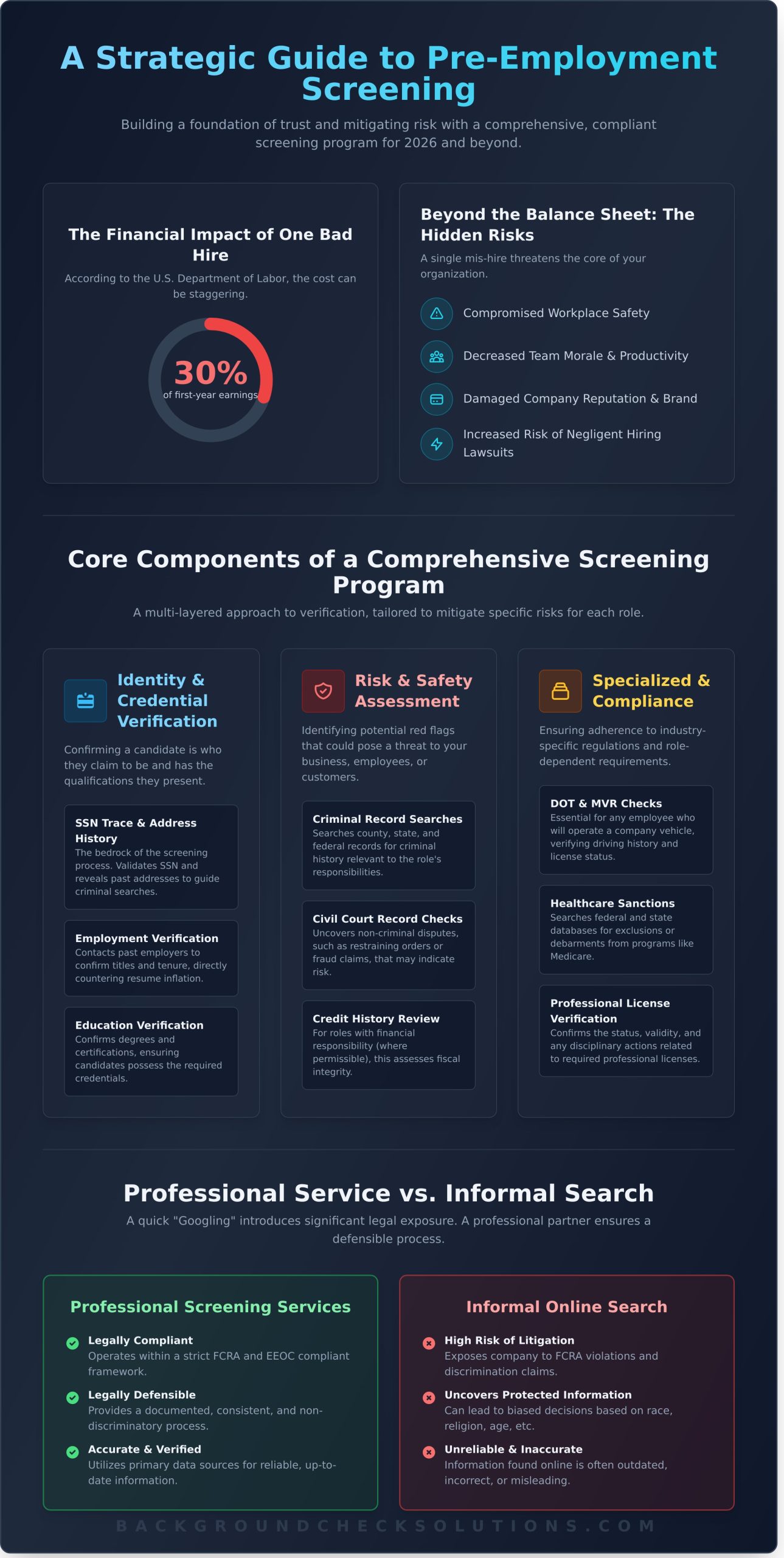
In today’s highly competitive and regulated business landscape, hiring is no longer just about finding talent; it is a critical exercise in risk management. Pre-employment screening is the systematic process of verifying a candidate’s background, qualifications, and history to ensure they are a suitable and safe fit for your organization. This methodical review, which is explored in this comprehensive guide to background checks, serves a core purpose: to mitigate risk, foster a secure workplace, and protect your company’s assets, reputation, and personnel. The financial stakes are substantial, with the U.S. Department of Labor estimating the cost of a single bad hire can exceed 30% of that individual’s first-year earnings due to turnover, lost productivity, and potential legal fees.
It is crucial to distinguish between professional pre-employment screening services and informal, ad-hoc searches of a candidate online. While a quick “Googling” may seem like a simple solution, it opens the door to significant legal exposure, including violations of the Fair Credit Reporting Act (FCRA) and potential discrimination claims based on protected information. A professional service ensures that all checks are conducted within a compliant, documented, and non-discriminatory framework, providing a defensible and reliable foundation for your hiring decisions.
Beyond the Resume: What Screening Uncovers
A professionally managed screening process delves far beyond the claims made on a resume or during an interview. It is designed to provide a verified, 360-degree view of a candidate, facilitating informed decisions by uncovering critical information. Key verification areas include:
- Professional & Academic Credentials: Confirming past employment, verifying educational degrees, and validating professional licenses to ensure the candidate possesses the qualifications they claim.
- Potential Risk Factors: Identifying red flags through criminal record searches, credit history reviews (where permissible), and civil court record checks that may indicate a risk to the business or its employees.
- Regulatory Compliance: Ensuring adherence to industry-specific mandates, such as Department of Transportation (DOT) requirements for drivers or healthcare-related sanctions checks.
The Rise of Negligent Hiring Litigation
Negligent hiring is a legal claim made against an employer when an employee harms another party, and the employer reasonably should have known about that employee’s potential risk through proper due diligence. For instance, if a company hires a field technician without a criminal background check who later assaults a customer, the company could be held liable. A thorough screening that revealed a prior history of violent offenses would have demonstrated due diligence and could have prevented the incident and the subsequent lawsuit. Engaging in comprehensive pre-employment screening services is not merely a best practice; it is a fundamental due diligence process that serves as a primary defense against such devastating litigation.
This is especially critical for field service businesses, where technicians regularly interact with the public. Once you’ve established a secure hiring process for your team, the next step is often to streamline their daily operations. Digitizing workflows can be a major advantage, and specialized software from providers like Repair-CRM is designed to help manage everything from scheduling to customer management for mobile workforces.
Core Components of a Comprehensive Screening Program
A robust screening strategy is not a monolithic process but a carefully assembled collection of individual checks, each designed to mitigate a specific type of risk. The most effective pre-employment screening services facilitate the creation of tailored packages, as the necessary depth of inquiry varies significantly by role, industry, and level of responsibility. Understanding these core components allows your organization to build a program that is both compliant and precisely aligned with your hiring objectives.
Identity & Credential Verification
This foundational category confirms that a candidate is who they claim to be and possesses the qualifications they have presented. It is the essential first step in building a trustworthy workforce and preventing costly mis-hires based on fraudulent information.
- SSN Trace & Address History: This check serves as the bedrock of the screening process. It validates a candidate’s Social Security Number and reveals past addresses, which is critical for determining the correct jurisdictions for subsequent criminal record searches.
- Employment Verification: We contact previous employers directly to confirm a candidate’s job titles, tenure, and other pertinent details. This service directly counters resume inflation and verifies that the applicant has the professional history they claim.
- Education Verification: By confirming degrees, certifications, and attendance dates from academic institutions, this check ensures that candidates possess the credentials required for the role, protecting your company from the liability of unqualified personnel.
Criminal History Searches
Identifying relevant criminal history is paramount for workplace safety, asset protection, and brand reputation. However, it is imperative that these searches are conducted in full compliance with all relevant laws, including the EEOC guidance on background checks, to ensure fair hiring practices.
- National Criminal Database Search: An extensive, multi-jurisdictional search that provides a broad view of a candidate’s potential criminal history, serving as an effective initial net to identify records that may exist outside their known residential areas.
- County & Statewide Criminal Searches: For more authoritative results, these searches access records directly from courthouse sources. They are used to confirm findings from the national database and uncover recent or un-digitized records.
- Federal Criminal Search: This distinct search uncovers crimes prosecuted at the federal level, such as financial fraud, interstate trafficking, or terrorism, which are not included in state or county-level searches.
- Sex Offender Registry Search: A crucial safety measure, this search scans national and state registries to identify individuals convicted of sex offenses, which is essential for any role involving interaction with the public or vulnerable populations.
Safety & Financial Responsibility Checks
Certain roles carry specific risks related to driving, financial management, or national security. These specialized pre-employment screening services provide the targeted insights needed to place candidates in sensitive positions with confidence.
- Motor Vehicle Records (MVR): Essential for any employee who will operate a company vehicle or drive as part of their job, an MVR check reveals license status, traffic violations, and other driving-related offenses to mitigate corporate liability.
- Credit Report: For positions with fiduciary duties, such as roles in accounting, finance, or executive leadership, a pre-employment credit report can offer insights into a candidate’s financial responsibility and judgment.
- Terrorist Watch List Search: This search scans various domestic and international watch lists to ensure compliance with regulations like the USA PATRIOT Act and is a critical component for roles in high-security sectors.
In addition to these standard pre-employment checks, a comprehensive approach to workplace safety and employee well-being often includes health-related screenings, especially for physically demanding or safety-sensitive roles. Proactive health management can reduce absenteeism and support a more productive workforce. For organizations interested in this area, services like Health Screen Test provide accessible preventive screenings to facilitate the early detection of common health conditions.
Designing Your Screening Policy: A Risk-Based Approach
A one-size-fits-all approach to background checks is not only inefficient but also introduces unnecessary legal risk. The most effective pre-employment screening services are built upon a tailored, risk-based policy that aligns the depth of the background check with the specific responsibilities of each role. Establishing a formal, written screening policy is a critical first step to ensure consistency, fairness, and defensibility in your hiring process. This policy must remain compliant with all relevant regulations, and the Federal Trade Commission guidance on FCRA provides an essential framework for employers. By categorizing positions into risk tiers, you can mitigate threats where they are most acute while streamlining hiring for lower-risk roles.
Tier 1: Foundational Checks for All Employees
This foundational tier applies to every new hire and is designed for roles with limited access to sensitive assets, such as entry-level positions with no cash-handling or driving duties. The goal is to establish identity and perform a baseline safety check. Recommended checks typically include:
- SSN Trace: Verifies identity and reveals address history.
- National Criminal Database Search: Provides a broad initial look at criminal records.
Tier 2: Enhanced Checks for Positions of Trust
For roles involving greater responsibility, such as managers, accounting staff, or IT administrators with system access, an enhanced level of due diligence is required. These checks verify credentials and assess integrity for positions of trust. This tier includes all Tier 1 checks, plus:
- County Criminal Search: A more precise search of court records in relevant jurisdictions.
- Employment Verification: Confirms work history and dates of employment.
- Credit Report: Assesses financial responsibility for roles with fiscal duties.
Tier 3: Comprehensive Checks for High-Risk & Regulated Roles
The most rigorous screening is reserved for executive-level, high-risk, or federally regulated positions, including commercial drivers (DOT) and healthcare professionals. The objective is to perform maximum due diligence and ensure full regulatory compliance. This comprehensive package builds upon Tiers 1 and 2 with:
- Motor Vehicle Record (MVR): Essential for any driving position.
- Education Verification: Confirms academic credentials.
- Federal Criminal Search: Uncovers crimes prosecuted at the federal level.
- Sanctions & Global Watchlist Checks: Screens against various government exclusion lists.
Navigating the Legal Landscape: FCRA and Compliance Essentials
Engaging in comprehensive pre-employment screening services is a critical component of modern risk mitigation, but it is governed by a strict framework of legal requirements. Compliance is not an optional consideration; it is a legal mandate designed to protect candidate rights. Failure to adhere to these regulations can result in significant litigation and financial penalties, undermining the very security you seek to build. The primary federal statute governing this process is the Fair Credit Reporting Act (FCRA), which dictates how employers must obtain, use, and act upon information in a consumer report.
The FCRA Process: Step-by-Step
The FCRA outlines a precise, multi-stage process that must be followed whenever a third-party consumer reporting agency is used to conduct a background check. Each step is designed to ensure transparency and fairness for the applicant.
- Step 1: Disclosure & Authorization. Before a background check is initiated, you must provide the candidate with a clear, standalone written disclosure stating that a report may be obtained for employment purposes. You must then secure the candidate’s written authorization to proceed.
- Step 2: Pre-Adverse Action Notice. If the background check reveals information that may lead you to deny employment, you are required to provide the candidate with a pre-adverse action notice. This includes a copy of their consumer report and a summary of their rights under the FCRA, giving them an opportunity to review the information and dispute any inaccuracies.
- Step 3: Adverse Action Notice. After allowing a reasonable period for the candidate to respond (typically five business days), if you proceed with the decision not to hire, you must issue a final adverse action notice. This notice informs the candidate of the final decision and provides details of the consumer reporting agency that furnished the report.
Understanding ‘Ban the Box’ Laws
Beyond the federal requirements of the FCRA, employers must also navigate a complex patchwork of state and local regulations. Prominent among these are ‘Ban the Box’ laws, which prohibit employers from asking about a candidate’s conviction history on an initial job application. The intent is to allow candidates to be judged on their qualifications first. Because these laws vary significantly by city and state, it is imperative to work with a knowledgeable partner and consult with legal counsel to ensure your hiring process and pre-employment screening services are tailored to all applicable jurisdictions.
Choosing a Partner: How to Implement Your Screening Program
Understanding the components of a robust background check is the first step; implementing a program with the right partner is what transforms that knowledge into a protective asset. The selection of a provider for your pre-employment screening services is not merely a transactional decision-it is a strategic partnership critical to mitigating risk, ensuring legal compliance, and safeguarding your organization’s integrity.
Criteria for Selecting a Screening Vendor
The efficacy of your hiring process is directly tied to the capabilities of your screening partner. A thorough evaluation should be centered on four fundamental pillars that ensure both security and operational efficiency.
- Accuracy & Data Sources: A provider’s value is measured by the quality of its data. Insist on a partner that utilizes direct access to primary sources, such as county court records, rather than relying on aggregated databases that may contain outdated or inaccurate information. Defensible hiring decisions depend on verified, precise intelligence.
- Turnaround Time: In a competitive hiring market, speed is essential, but it must never come at the expense of thoroughness. An optimal partner balances swift report delivery with the meticulous verification processes required to ensure complete accuracy.
- Compliance Expertise: The legal landscape governing background checks is complex and constantly evolving. Your provider must demonstrate deep, actionable knowledge of the Fair Credit Reporting Act (FCRA) and relevant state and local laws, serving as a reliable resource for navigating requirements like pre-adverse and adverse action.
- Pricing Structure: A transparent and flexible pricing model is the hallmark of a client-focused provider. Evaluate whether a rigid subscription model or an adaptable pay-per-use structure best aligns with your organization’s hiring volume and budgetary needs.
The Background Check Solutions Advantage
Since 1982, Background Check Solutions has provided a superior standard of diligence and support to businesses nationwide. We have built our reputation on an unwavering commitment to accuracy, leveraging direct access to over 8,000 databases and primary data sources to deliver comprehensive, verified results that empower confident hiring.
We believe professional pre-employment screening services should be accessible to all businesses, regardless of hiring frequency. Our transparent, pay-per-report model is designed for maximum flexibility and cost-effectiveness, completely eliminating subscriptions, monthly retainers, and hidden fees. You only invest in the reports you need, facilitating prudent financial management while upholding the highest standards of security. Partner with an expert dedicated to protecting your assets and reputation. Request a consultation to build your compliant screening policy.
Securing Your Workforce: The Strategic Imperative of Diligent Screening
As we advance into 2026, it is unequivocally clear that a robust screening program is a strategic cornerstone for mitigating risk and protecting your organization’s integrity. A meticulously designed, risk-based policy is essential for effectiveness, and navigating the complex legal landscape, including FCRA compliance, is non-negotiable for avoiding significant liability. The success of your hiring strategy ultimately hinges on the quality and thoroughness of your vetting process.
Implementing comprehensive pre-employment screening services requires a partner with proven expertise and an unwavering commitment to accuracy. With industry leadership dating back to 1982 and direct access to over 8,000 municipal, county, state, and federal databases, Background Check Solutions provides the precision you demand. Our flexible pay-per-report model-free from sign-up fees, monthly minimums, or annual contracts-ensures our solutions are as accessible as they are thorough. Secure your hiring process with our reliable, pay-per-report screening services. Take the definitive step toward building a more secure, compliant, and trustworthy workforce today.
Frequently Asked Questions
What information appears on a pre-employment background check?
A report from comprehensive pre-employment screening services provides a multi-faceted view of a candidate’s history, tailored to the specific requirements of the role. Information typically includes verified criminal records from county, state, and federal sources, along with employment and education history verification. Depending on the position’s demands, the report may also incorporate a motor vehicle record (MVR) check, credit history analysis, and confirmation of professional licenses, ensuring a thorough and relevant candidate assessment.
How long does a pre-employment screening take to complete?
The turnaround time for pre-employment screening services is typically between two to five business days, though this can vary. Factors influencing this timeline include the scope of the search, the responsiveness of educational institutions or past employers, and the specific jurisdictions being searched. Our advanced platform, combined with dedicated analyst support, is engineered to streamline this process, facilitating rapid yet precise results to maintain your hiring momentum and secure top talent without unnecessary delays.
What can legally disqualify a candidate during a background check?
A candidate can be legally disqualified if the information discovered is directly relevant to the job’s responsibilities, a principle guided by the EEOC’s “business necessity” and “job-relatedness” standards. For instance, a conviction for financial fraud could disqualify an applicant for an accounting position. It is imperative that employers apply their screening criteria consistently across all candidates to mitigate risk and ensure full compliance with anti-discrimination laws, thereby avoiding potential litigation.
Do I need to get a candidate’s permission to run a background check?
Yes, obtaining a candidate’s explicit written consent is a non-negotiable legal requirement before initiating a background check. This mandate is stipulated by the Fair Credit Reporting Act (FCRA), which governs the use of consumer reports for employment purposes. The candidate must be provided with a clear, standalone disclosure form and must authorize the check in writing. Failure to adhere to this protocol represents a significant compliance violation and exposes the organization to legal liability.
What is the difference between a national, federal, and county criminal search?
These searches target distinct legal jurisdictions to create a comprehensive criminal history. A county search is the most critical, as it examines records directly at the source where the vast majority of crimes are prosecuted. A federal search investigates crimes against the U.S. government, such as interstate trafficking or tax evasion. A national criminal database search is a broad, multi-jurisdictional tool that provides valuable pointers but must always be verified at the county level for accuracy and compliance.
How far back do pre-employment background checks go?
The lookback period for pre-employment background checks is governed by federal and state laws, most notably the FCRA. Generally, non-conviction information, such as arrests, is limited to a seven-year history. However, criminal convictions can typically be reported indefinitely, though some states impose their own limitations. It is also important to note that these reporting restrictions may not apply for positions with a salary exceeding a certain threshold, which varies by state.
Can a candidate dispute the information found in their background check report?
Absolutely. The FCRA grants candidates the explicit right to dispute any information they believe to be inaccurate or incomplete in their background check report. If an employer is considering taking adverse action based on the report, they must first provide the candidate with a copy of the report and a summary of their rights. This pre-adverse action process allows the candidate time to initiate a dispute with the screening provider, ensuring fairness and accuracy.
What are the most common red flags to look for on a screening report?
Common red flags on a screening report extend beyond criminal convictions and warrant careful review. These include material discrepancies between the candidate’s application and verified employment or education history, undisclosed criminal records, or a pattern of behavior that is inconsistent with the role’s requirements. Identifying these inconsistencies is a critical step in mitigating potential workplace risk and ensuring the integrity of your hiring decisions, thereby protecting your organization’s assets and reputation.
Comments are closed.