Texas Statutes and Landlord Rules for Reporting Tenant Credit History: A 2026 Compliance Guide
March 6th, 2026 by Dodie
For Texas landlords and property managers, the threat of litigation from an improperly handled tenant denial is a persistent and costly risk. This operational vulnerability is compounded by an evolving regulatory landscape, where new portable screening report laws for 2025/2026 add another layer of complexity. Navigating the intricate web of Texas statutes landlord report tenants credit history requirements, while simultaneously adhering to the federal FCRA, is no longer just best practice-it is an essential safeguard for your business.
This definitive 2026 compliance guide is engineered to provide the clarity and confidence required to master this legal intersection. We will deliver a precise checklist for legally obtaining and assessing tenant credit reports, demystify the critical requirements for issuing Adverse Action notices, and ensure you can facilitate a screening process that is both effective and meticulously defensible. The outcome is a streamlined, compliant procedure that mitigates risk and provides the peace of mind necessary to protect your investments.
Key Takeaways
- Understand the dual-compliance framework of the federal FCRA and Texas state law to ensure your tenant screening process is legally defensible.
- Master the disclosure rules under Texas Property Code § 92.3515, as these specific texas statutes landlord report tenants credit history regulations are foundational to mitigating risk.
- Prepare your operations for the 2026 introduction of Portable Tenant Screening Reports and learn how they will impact your application workflow.
- Implement a compliant Adverse Action process to legally deny applicants based on credit information, thereby protecting your business from potential litigation.
- Learn why relying on verified, primary-source data is a superior risk management strategy compared to using aggregated information from DIY background checks.
The Legal Framework: Federal FCRA vs. Texas State Statutes
For landlords in Texas, from urban centers like Houston to growing communities like Lago Vista, navigating the legal requirements for tenant screening is a critical risk mitigation strategy. The process is governed by a dual-layered legal framework, where federal law establishes a mandatory baseline and state statutes introduce additional obligations. At the federal level, the entire system of credit reporting is regulated by the Fair Credit Reporting Act (FCRA), an act enforced by the Federal Trade Commission (FTC). Texas law does not override this federal statute but supplements it, creating a comprehensive compliance environment that demands meticulous attention from property managers and independent landlords alike.
The Supremacy of the FCRA in Credit Reporting
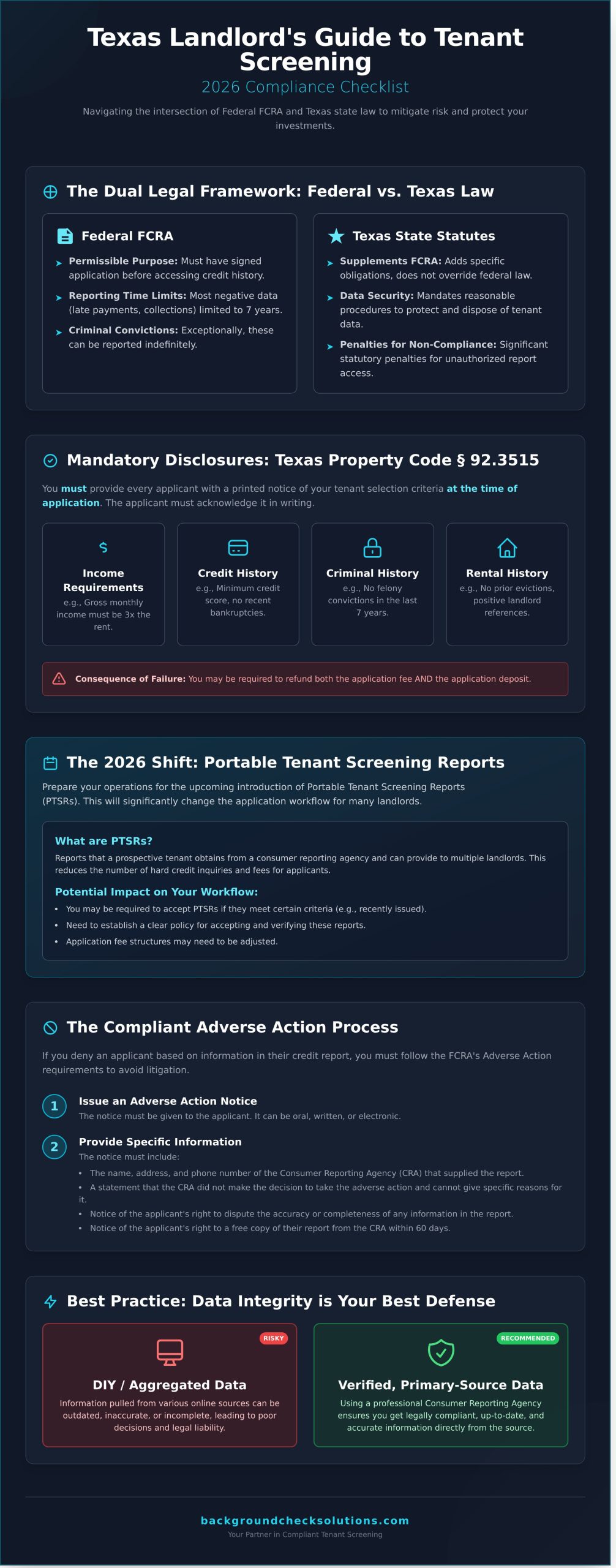
The FCRA provides the foundational rules for how consumer reporting agencies can collect and share information. Landlords must understand its core tenets to remain compliant. Key provisions include:
- Reporting Time Limits: Most negative financial information, such as late payments or collection accounts, cannot be reported for more than seven years.
- Criminal Convictions: In a notable exception relevant to Texas, criminal convictions can be reported indefinitely, providing landlords with a more extensive view of an applicant’s background.
- Permissible Purpose: A landlord must have a legally recognized “permissible purpose”-specifically, a signed application for a lease-before accessing a prospective tenant’s credit history. This principle is central to the compliant use of texas statutes landlord report tenants credit history data.
Texas-Specific Variations in Consumer Privacy
Beyond the federal FCRA, the Texas Business and Commerce Code imposes specific duties on businesses, including landlords, that handle sensitive consumer data. This statute mandates reasonable procedures to protect and properly dispose of tenant information, directly impacting data security protocols. Furthermore, Texas law provides its own precise definition of a “consumer report.” Any failure to adhere to these state-level requirements, such as accessing a report without authorization, can result in significant statutory penalties, underscoring the importance of a precise and legally sound screening process.
Key Texas Property Code Provisions for Tenant Credit Checks
In Texas, the process of screening prospective tenants is not merely a business practice; it is a regulated activity governed by specific statutes designed to ensure fairness and transparency. For landlords, understanding these legal parameters is critical to mitigating risk and maintaining compliance. The cornerstone of these regulations is found in the Texas Property Code, which outlines explicit requirements for how a landlord must handle applications, fees, and the communication of screening criteria. Adhering to these texas statutes landlord report tenants credit history protocols is essential for building a legally sound leasing operation and avoiding potential litigation.
Mandatory Selection Criteria Disclosures
Under Texas Property Code § 92.3515, a landlord is required to provide every applicant with a printed notice of their tenant selection criteria. This disclosure must be provided at the time the application is submitted. This requirement is explicitly detailed within the Texas Property Code Chapter 92, which mandates that the criteria be comprehensive and acknowledged in writing by the applicant. The notice must include, at a minimum, the grounds on which an application may be denied, such as:
- Income requirements (e.g., monthly income must be three times the rent)
- Credit history standards (e.g., minimum credit score, no recent bankruptcies)
- Criminal history review (e.g., no felony convictions within a certain timeframe)
- Previous rental history verification
Failure to provide this notice and secure the applicant’s signature of acknowledgment can result in the landlord being required to refund both the application fee and any application deposit.
Application Fees and the Cost of Credit Reports
Texas law distinguishes clearly between an application fee and an application deposit. An application fee is a nonrefundable sum collected to cover the actual costs of screening an applicant, including the expense to run a background check and report tenants’ credit history. Conversely, an application deposit is a refundable sum that secures the property for the applicant and must be returned if they are rejected. To remain compliant, the application fee must be a reasonable reflection of the landlord’s out-of-pocket expenses. Best practice dictates meticulous documentation of all screening costs, such as invoices from your credit reporting agency, to substantiate the fee amount in the event of a dispute.
Finally, landlords must operate with a sense of urgency. The law includes a “Deemed Rejected” rule: if you do not notify an applicant of your decision by the end of the seventh day after receiving their completed application, they are considered automatically rejected by statute. This statutory deadline underscores the importance of a streamlined, efficient, and well-documented screening process.
The 2026 Shift: Portable Tenant Screening Reports in Texas
Beginning in 2025 and fully effective by 2026, Texas landlords must navigate a significant legislative change: the mandatory acceptance of Portable Tenant Screening Reports (PTSRs). This development modifies the traditional application workflow and introduces new compliance considerations. While intended to reduce costs for prospective tenants, this shift requires landlords to understand the new framework to effectively mitigate risk and maintain robust screening standards. The new law fundamentally alters the landscape for how a texas statutes landlord report tenants credit history is procured and reviewed, placing a greater emphasis on data verification.
Statutory Standards for Portable Reports
For a tenant-provided report to be legally considered “portable” and thus acceptable, it must meet strict statutory criteria designed to ensure its validity and relevance. A compliant report must be comprehensive, current, and secure. Key requirements include:
- Required Elements: The report must contain a complete review of the applicant’s credit history, nationwide eviction records, and a comprehensive criminal background check.
- The 30-Day Freshness Rule: The screening data must have been generated within the last 30 days, ensuring the information is timely and accurately reflects the applicant’s current status.
- The “Direct from Provider” Requirement: To prevent tampering, the report must be made available to the landlord directly from the consumer reporting agency that compiled it. A printed copy or a forwarded email from the applicant is not sufficient and may be rejected.
Landlord Liability and the Right to Independent Screening
The statute provides “safe harbor” provisions, protecting landlords from liability for decisions made in good faith based on information within an accepted PTSR. If a landlord accepts a compliant report, they generally cannot charge the applicant a separate application fee. However, this does not eliminate a landlord’s right to ensure an applicant meets their established rental criteria. As outlined in Texas Property Code § 92.3515, landlords must provide tenants their selection criteria, and verifying this information remains paramount. Strategic reasons to run a fresh report through a trusted partner like Background Check Solutions include verifying data integrity, ensuring the report covers all jurisdictions relevant to your risk profile, and maintaining a consistent, defensible screening process for all applicants. This ensures your final decision is based on verified, primary-source data tailored to your specific requirements.
Legal Requirements for Denying Applicants Based on Credit History
When a rental application is denied, either wholly or in part, based on information from a consumer report, landlords are legally obligated to follow a specific process known as “adverse action.” This protocol is mandated by the federal Fair Credit Reporting Act (FCRA) and is a critical component of risk mitigation. Failure to comply can result in significant legal penalties and litigation. This requirement also applies to “conditional approvals,” such as requiring a higher security deposit or a co-signer based on the applicant’s credit profile.
Issuing the Adverse Action Notice
The cornerstone of this process is the Adverse Action Notice, a formal letter that must be provided to the rejected applicant. While the law allows for a “reasonable” timeframe, best practice dictates sending the notice immediately to ensure compliance and maintain a clear, defensible record. This notice must contain specific, non-negotiable information:
- A clear statement that the decision was based on information in a consumer report.
- The name, address, and phone number of the credit bureau that supplied the report (e.g., Experian, TransUnion, or Equifax).
- A statement that the credit bureau did not make the denial decision and cannot provide the reasons for it.
- Notice of the applicant’s right to obtain a free copy of their credit report from the bureau within 60 days.
- Notice of the applicant’s right to dispute the accuracy or completeness of any information in the report with the credit bureau.
Texas Disclosure Rules for Criminal and Credit Denials
The texas statutes landlord report tenants credit history regulations align closely with the FCRA but demand meticulous documentation. If a credit score was a primary factor in the denial, the notice must also disclose that score and the key factors that adversely affected it. When a denial is based on a combination of credit and criminal history, it is imperative to clearly document the specific, non-discriminatory criteria used for the decision. This creates a robust defense against potential Fair Housing Act complaints. Properly navigating the nuances between federal and texas statutes landlord report tenants credit history requirements is essential for maintaining compliance. Partnering with a professional screening provider like Background Check Solutions can streamline this process, ensuring every adverse action is handled with precision and legal integrity.
Best Practices for Texas Landlords: Mitigating Risk in 2026
As the Texas rental market continues to evolve, landlords must adopt a proactive stance on risk mitigation. Relying on do-it-yourself background checks or generic online services presents a significant litigation risk. These methods often pull from incomplete, aggregated web scrapes rather than “Primary Source” data-the official court records and verified databases. This distinction is critical; inaccurate information can lead to discriminatory housing practices claims and violations of the Fair Credit Reporting Act (FCRA).
To ensure compliance and protect your assets, a professional screening partner is indispensable. A pay-per-report transactional model offers a streamlined, cost-effective solution, allowing landlords to access enterprise-level data without the burden of subscriptions. This approach facilitates adherence to the complex web of texas statutes landlord report tenants credit history regulations by ensuring every report is sourced, compiled, and delivered in a compliant manner. Background Check Solutions provides this precise framework, tethering advanced technology to human oversight to deliver peace of mind with every screening.
Choosing a Professional Screening Partner
A credible partner provides direct access to over 8,000 municipal and federal databases, ensuring a comprehensive criminal and eviction history search. In the fast-moving Texas rental market, turnaround time is paramount; a swift, accurate report can be the deciding factor in securing a qualified tenant. Beyond credit, verifying Social Security numbers and employment history provides a crucial secondary layer of validation, painting a complete picture of an applicant’s reliability.
Conclusion: Building a Bulletproof Screening Strategy
Ultimately, a robust screening process is about aligning your operations with both the Texas Property Code and federal FCRA mandates. By leveraging a professional consumer reporting agency, you replace guesswork with verified data. This disciplined approach is the cornerstone of a successful and legally sound rental business.
Just as a bulletproof screening process protects you legally, a well-maintained property protects your physical asset and tenant relationships. In a state like Texas, this includes ensuring a reliable HVAC system; you can learn more about BulletProof Air and their services for landlords.
For the Lago Vista landlord and property managers across the state, the final checklist is simple:
- Obtain signed consent from every applicant before screening.
- Use a professional, FCRA-compliant screening service.
- Apply your rental criteria consistently and fairly to all applicants.
- Follow proper adverse action procedures if you deny an applicant based on the report.
Protect your investment with FCRA-compliant reports from Background Check Solutions and build your rental business on a foundation of confidence and compliance.
Ensure Compliance and Mitigate Risk in Your Tenant Screening Process
Navigating the complex texas statutes landlord report tenants credit history requires a meticulous understanding of both federal FCRA mandates and state-specific property codes. As the 2026 shift towards portable tenant screening reports approaches, landlords must proactively adapt their processes to remain compliant. Furthermore, strict adherence to the legal requirements for issuing adverse action notices is not merely a best practice but a critical defense against potential litigation.
To fortify your screening process with precision, partner with a trusted industry leader. Since 1982, Background Check Solutions has provided landlords with comprehensive reports sourced from over 8,000 municipal, county, and federal databases. We streamline your compliance efforts with no monthly fees or sign-up costs-you pay only for the reports you need.
Protect your investments and secure peace of mind. Order Your Comprehensive Tenant Credit Report Today and let our expertise be the foundation of your tenant selection process. By staying informed and utilizing professional resources, you can confidently build a secure and successful rental business.
Frequently Asked Questions
Can a Texas landlord deny an applicant solely based on a low credit score?
Yes, a landlord in Texas can legally deny an application based on a low credit score, provided this criterion is applied consistently and non-discriminatorily to all applicants. The denial must be based on legitimate business reasons related to financial risk. To mitigate potential litigation, this policy should be clearly documented in your tenant selection criteria and provided to every applicant before they pay an application fee, ensuring a transparent and defensible screening process.
What specific Texas Property Code section governs tenant screening?
The primary statute governing tenant screening in Texas is Property Code § 92.3515, “Notice of Tenant Selection Criteria.” This section mandates that landlords provide applicants with a printed notice of all selection criteria at the time of application. This includes standards for criminal history, previous rental history, current income, and credit history. Adherence to this statute is a critical component of maintaining legal compliance and mitigating risk in your leasing operations.
How long does a criminal conviction stay on a tenant background check in Texas?
In Texas, there is no state law that limits the reporting period for criminal convictions; therefore, they can remain on a background check indefinitely. However, the federal Fair Credit Reporting Act (FCRA) limits the reporting of arrest records that did not lead to a conviction to seven years. Landlords must establish clear, non-discriminatory policies regarding criminal records to ensure compliance with Fair Housing guidelines and avoid potential legal challenges.
Are Texas landlords required to accept portable tenant screening reports in 2026?
As of the current legal framework, Texas does not mandate that landlords accept portable tenant screening reports, and no such requirement is scheduled for 2026. Landlords retain the right to conduct their own comprehensive screening through a trusted third-party provider. This ensures the data is verified, accurate, and compliant with their specific, pre-established criteria, which is a crucial step for effective risk management and property protection.
What is the maximum application fee a landlord can charge in Texas?
Texas law does not stipulate a statutory maximum for tenant application fees. However, the fee charged must be reasonable and should correspond to the actual costs the landlord incurs to screen an applicant, such as background and credit check services. Charging an excessive fee that does not reflect actual expenses could be construed as a discriminatory practice, so it is a best practice to maintain fees that are both justifiable and transparent.
What happens if a landlord fails to provide the required selection criteria notice?
Failing to provide the selection criteria notice as required by Texas Property Code § 92.3515 can lead to significant penalties. If an applicant is rejected and the landlord did not provide the notice, the landlord is presumed to have acted in bad faith. The applicant may be legally entitled to recover the application fee, a $100 statutory penalty, and reasonable attorney’s fees, making compliance with this notice requirement essential for risk mitigation.
Do I need a tenant’s written consent to run a credit check in Texas?
Yes, obtaining explicit written consent is a mandatory prerequisite for running a credit check on a prospective tenant. This requirement is enforced by the federal Fair Credit Reporting Act (FCRA), which governs all states. This consent provides the “permissible purpose” needed to access their files. Following the proper texas statutes landlord report tenants credit history procedures, including securing this consent, is a critical compliance step that protects both the landlord from litigation and the applicant’s privacy.
How does an Adverse Action notice work under Texas law?
The Adverse Action notice process is governed by the federal FCRA, which all Texas landlords must follow. If you deny an applicant, require a co-signer, or charge a higher deposit based wholly or partly on information in their consumer report (e.g., credit or criminal history), you must provide them with an Adverse Action notice. This notice must identify the consumer reporting agency used and inform the applicant of their right to obtain a free copy of the report and dispute its accuracy.
If you are facing the threat of a lawsuit—whether it stems from the tenant screening process or other liability issues such as a personal injury claim on your property—it is crucial to seek professional legal advice. An experienced law firm can help protect your interests and navigate the complexities of litigation. For instance, Texans have relied on established legal practices like The Burkett Law Firm for decades to handle challenging legal matters.
What should a landlord do if facing a lawsuit?
Comments are closed.