Comprehensive Tenant Screening Services: The Landlord’s Guide to Risk Mitigation in 2026
March 12th, 2026 by Dodie
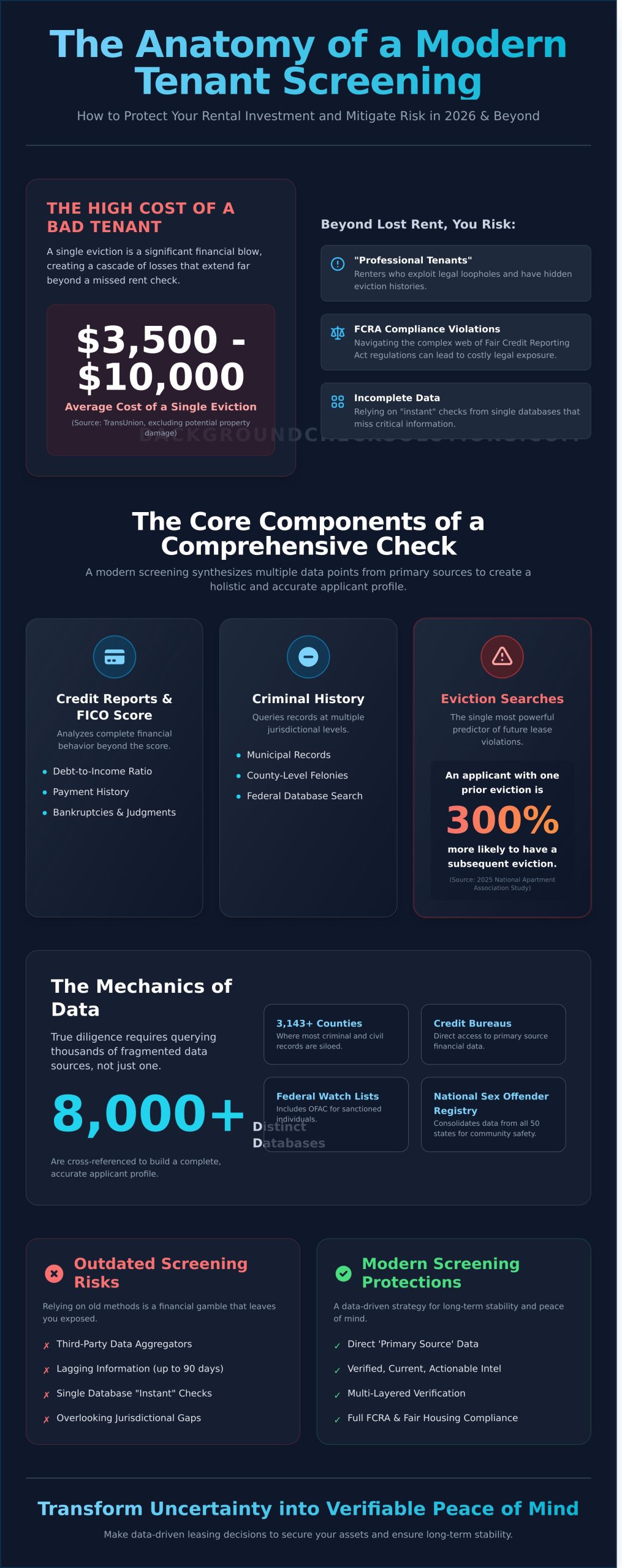
A single eviction costs the average landlord between $3,500 and $10,000 in lost rent and legal fees, a figure from TransUnion that doesn’t even account for potential property damage. You already know the immense financial and emotional toll a problematic tenant can take; the anxiety over ‘professional tenants’ with hidden eviction histories or the complex web of FCRA regulations is a significant concern for any property owner. It’s a risk you simply can’t afford to ignore.
This guide is engineered to mitigate those exact threats. We will demonstrate how comprehensive tenant screening services transform that uncertainty into verifiable peace of mind. You’ll discover how to protect your rental investment by leveraging professional-grade data from primary sources, implementing a legally compliant rejection and approval process, and utilizing a transparent, cost-effective pay-per-report model. We’ll walk through the critical components of a thorough background check, ensuring you can confidently secure your assets in 2026 and beyond.
Key Takeaways
- Understand how comprehensive risk assessment has evolved beyond simple credit inquiries, providing a multi-layered verification process to protect your assets.
- Analyze the financial implications of various tenant screening services models to identify how subscription traps and tenant-paid fees can impact your bottom line.
- Grasp the necessity of a multi-database approach to overcome the fragmented US public records system, ensuring no critical information is overlooked.
- Mitigate legal exposure by mastering the core requirements of the Fair Credit Reporting Act (FCRA), from obtaining applicant consent to navigating adverse action procedures.
What Are Professional Tenant Screening Services?
Tenant screening is a comprehensive risk assessment process, not merely a procedural step. For property owners and managers in Lago Vista, it functions as the most critical due diligence measure to protect an asset. The industry has evolved significantly since the early 2000s, moving from rudimentary credit checks to multi-layered background verifications that analyze an applicant’s financial, criminal, and rental history with precision. This sophisticated evaluation involves three primary stakeholders: the landlord or property manager seeking to mitigate risk, the rental applicant providing sensitive personal data, and the professional screening partner responsible for delivering accurate, compliant, and actionable intelligence.
By 2026, the technology underpinning professional tenant screening services has rendered outdated methods obsolete. The most significant advancement is the industry-wide shift toward ‘primary source’ data acquisition. Instead of relying on third-party data aggregators, which can introduce delays and inaccuracies, cutting-edge platforms now integrate directly with credit bureaus, county courthouses, and federal databases. This advanced approach refines the traditional tenant screening process by ensuring the information you receive is verified at its origin, providing a clear and current picture of each applicant.
The Core Components of a Modern Background Check
A truly comprehensive screening report synthesizes multiple data points to create a holistic applicant profile. Each component serves a distinct purpose in assessing potential risk:
- Credit Reports and FICO Scores: We look beyond the three-digit FICO score to analyze the applicant’s complete financial behavior. This includes examining their debt-to-income ratio, payment history on revolving credit and installment loans, and public records for bankruptcies or civil judgments, which collectively signal financial responsibility.
- Criminal History: A thorough search must query records at multiple jurisdictional levels. This includes municipal records for minor infractions, county-level searches for the majority of misdemeanors and felonies, and a federal database check for crimes like wire fraud or interstate offenses that don’t appear in local records.
- Eviction Searches: This is the single most powerful predictor of future lease violations. A 2025 study from the National Apartment Association confirmed that an applicant with a single prior eviction is over 300% more likely to have a subsequent eviction, making this check non-negotiable for asset protection.
Why ‘Good Enough’ Screening Is a Financial Risk
Relying on incomplete or instant online checks is a significant financial gamble. The average cost of a single eviction in Texas, factoring in legal fees, lost rent, and property turnover costs, can exceed $8,500. Professional tenant screening is the primary defense mechanism a property owner has against professional, litigious renters who exploit legal loopholes. Comprehensive data sourced directly from the courthouse and credit bureaus mitigates a property owner’s most significant risks, from non-payment and property damage to potential liability issues arising from criminal activity. It transforms the leasing process from a speculative decision into a data-driven business strategy designed for long-term stability and peace of mind.
The Mechanics of Data: Accessing 8,000+ Databases
A comprehensive background check is not a single query; it’s a meticulous investigation into a complex and fragmented public records system. The United States doesn’t have one central repository for criminal and civil data. Instead, records are siloed across more than 3,143 counties, thousands of municipalities, and various state and federal agencies. Relying on a single, aggregated database for your tenant screening services is an exercise in risk, as these sources can lag behind official court filings by as much as 90 days. True diligence requires a multi-layered approach that queries over 8,000 distinct databases to build a complete and accurate applicant profile.
The foundational layer of this process involves searches that are critical for community safety. A search of the National Sex Offender Registry, which consolidates data from all 50 states, is an absolute necessity for protecting your property and tenants. Similarly, checking against federal watch lists, such as the Office of Foreign Assets Control (OFAC) list, ensures you are not leasing to individuals on government-sanctioned terrorist or narcotics trafficking watch lists. These aren’t optional steps; they are the baseline for responsible property management in Lago Vista.
National vs. County-Level Criminal Searches
Think of a National Criminal Database search as casting a wide net. It’s an invaluable tool for generating ‘leads,’ flagging potential criminal records an applicant may have in states or counties they failed to disclose. However, this national data should never be the final word. The definitive ‘proof’ resides at the county courthouse. A direct, county-level search accesses the primary source records, providing the most accurate, up-to-date, and legally defensible information. Background Check Solutions bridges this critical gap by using the national search to identify jurisdictions of interest and then deploying our network to verify findings directly at the source, ensuring you act on verified facts, not just pointers.
Verifying the Essentials: SSN and Employment
Beyond criminal history, a tenant’s identity and financial stability are paramount. An SSN Verification is the first step, confirming that the Social Security Number provided is valid, was issued to the applicant, and is not associated with a deceased individual. This simple check is a powerful defense against identity fraud. Subsequently, Employment Verification confirms an applicant’s ability to pay rent by contacting employers directly to verify their position, tenure, and income. As these verifications constitute a consumer report, it is imperative that landlords comply with the Fair Credit Reporting Act (FCRA) to avoid significant legal penalties. For a more holistic view of an applicant’s responsibility, Motor Vehicle Records (MVR) can also reveal patterns of behavior, including DUIs or license suspensions, that may be relevant to your risk assessment.
Synthesizing these disparate data points into a coherent, compliant, and actionable report is the core function of professional tenant screening services. The distinction between using aggregated data and insisting on primary source verification is the difference between making an assumption and making a secure, informed decision. Explore our tailored screening packages for Lago Vista landlords to see how we deliver this critical peace of mind.
Pay-Per-Report vs. Subscription Models: Which Is Better?
Selecting a partner for your tenant screening is a critical financial decision. The pricing structure you choose directly impacts your operational budget, the quality of your applicant pool, and your ability to mitigate risk effectively. For Lago Vista landlords and property managers, understanding the difference between pay-per-report and subscription-based tenant screening services is fundamental to protecting your assets without incurring unnecessary expenses.
Many landlords are initially drawn to two seemingly attractive models: “free” screening and low-cost monthly subscriptions. However, a deeper analysis reveals significant hidden costs and operational inefficiencies that can prove detrimental. A transactional, pay-per-report model offers a transparent and financially sound alternative that aligns with the variable needs of property management.
The True Cost of ‘Free’ Tenant Screening
Services marketed as “free” for landlords operate by shifting the entire financial burden onto the applicant, often charging them exorbitant fees ranging from $40 to $55 per application. This approach can severely limit your access to the most qualified tenants. Highly desirable applicants often apply to multiple properties; they are unlikely to pay over $200 in cumulative fees and will simply move on to properties with more reasonable processes. This leaves you with a smaller, potentially less qualified applicant pool.
More critically, these “free” platforms frequently compromise on data quality to maintain their profit margins. Their criminal and eviction searches may be restricted to a single state’s database or exclude crucial nationwide records. A comprehensive screening process is a foundational risk mitigation strategy, yet these superficial checks create a dangerous illusion of security. In contrast, a transactional pricing model ensures you only pay for the precise, comprehensive data you actually need, directly linking your cost to a tangible, high-quality report.
Scalability for Property Managers and Employers
For professional property managers and corporate entities in the Lago Vista area, the pay-per-report model offers unparalleled scalability and financial clarity. Unlike a fixed monthly subscription fee that becomes a static overhead cost, transactional billing facilitates much simpler accounting. Each report’s cost can be directly allocated to a specific property or owner, streamlining expense tracking and cost-pass-through procedures without ambiguity.
This model is designed to grow with your portfolio. For corporate clients managing over 50 units or requiring high-volume background checks, we develop customized pricing structures and bulk discounts to ensure cost-effectiveness at scale. This flexibility extends to the screening process itself. You can establish a standard screening package and add specific searches, such as a Federal Criminal records check or a Motor Vehicle Report, on a per-applicant basis. This granular control ensures you’re not paying for irrelevant data and can tailor the depth of each background check to the specific requirements of the role or property, a level of precision that rigid subscription packages simply cannot offer.
Ensuring Compliance: FCRA and Fair Housing Standards
Executing a tenant screening process in Lago Vista requires more than just gathering data; it demands strict adherence to federal law to mitigate significant legal and financial risk. The two primary pillars of this legal framework are the Fair Credit Reporting Act (FCRA) and the Fair Housing Act. Understanding and implementing these regulations is not an optional best practice; it’s a fundamental requirement for any landlord or property manager. Failure to comply can result in civil penalties starting at $1,000 per violation, as enforced by the Consumer Financial Protection Bureau (CFPB) and the Department of Housing and Urban Development (HUD).
The FCRA governs the use of consumer reports, which include everything from credit histories and eviction records to criminal background checks. Before you can access any of this information, you must obtain clear, written consent from the applicant. This authorization cannot be buried within the lease application; it must be a standalone document that explicitly informs the applicant that a consumer report may be used to make a leasing decision. This initial step is your first line of defense in maintaining a compliant screening process.
While the FCRA dictates how you obtain and use information, the Fair Housing Act governs how you make your decision. To prevent discrimination claims, you must establish objective, consistent screening criteria and apply them uniformly to every applicant. This uniformity can sometimes require additional steps, such as obtaining professional translations for documents like pay stubs or rental history provided in a foreign language; you can learn more about Translators USA for these situations. For example, if your policy requires a minimum credit score of 650 and an income of three times the rent, this standard must be applied to everyone, without exception. Documenting these criteria provides a defensible, business-related justification for your leasing decisions, which is critical should a denial ever be questioned. Partnering with professional tenant screening services facilitates this by creating a standardized, auditable trail for every applicant.
The Adverse Action Workflow
If you deny an applicant, require a co-signer, or charge a higher security deposit based on information from a consumer report, you have taken “adverse action.” The FCRA mandates a specific, multi-step process for this scenario to protect consumer rights. This workflow is non-negotiable.
- Step 1: The Pre-Adverse Action Notice. Before finalizing your decision, you must send the applicant a pre-adverse action letter. This communication must include a copy of the consumer report that influenced your decision and the official “A Summary of Your Rights Under the Fair Credit Reporting Act” document.
- Step 2: Allow Time for Dispute. The applicant must be given a reasonable period, typically interpreted by courts as five business days, to review the report and dispute any inaccuracies directly with the consumer reporting agency that furnished it.
- Step 3: The Final Adverse Action Notice. After the waiting period, you may issue a final notice. This letter must state the specific adverse action taken, provide the name and contact information for the reporting agency, and inform the applicant of their right to obtain another free copy of their report within 60 days.
Data Privacy and Security in 2026
In an era of increasing data breaches, protecting an applicant’s Personally Identifiable Information (PII) is a paramount concern. Professional screening providers utilize encrypted, secure online portals for the entire application and screening process. This protocol prevents sensitive data like Social Security numbers and bank account details from being transmitted over insecure channels like email, where 91% of cyberattacks begin, according to a 2023 Deloitte report. This technological safeguard is essential for modern compliance. Background Check Solutions adheres to all 2026 federal data protection standards.
Navigating the complex intersection of the FCRA, Fair Housing laws, and data security protocols can be a formidable challenge for even the most diligent property managers. Let our FCRA-certified team manage your legal obligations. Explore our compliant tenant screening solutions today.
Selecting the Right Screening Partner for Your Business
Making an informed decision about your Lago Vista rental property hinges on the quality of your applicant data. The right partner doesn’t just provide information; they deliver a strategic advantage. Your selection process should prioritize three non-negotiable pillars: unwavering accuracy, operational speed, and strict FCRA compliance. A failure in any one of these areas exposes your business to significant financial and legal risk. Accuracy ensures you’re acting on verified facts, speed allows you to secure qualified tenants before your competition, and compliance protects you from costly litigation.
For independent landlords and property managers who require professional-grade tools without the burden of monthly subscriptions or minimums, the choice becomes clear. Background Check Solutions operates on a flexible, pay-per-report model, giving you direct access to the same powerful resources used by large corporations. Our foundation is built on the four-decade legacy of our parent company, Tenant Screening Services, LLC, which has been a trusted industry leader since its establishment in 1982. This history isn’t just a number; it represents a long-standing commitment to integrity and precision in the data we provide.
The Background Check Solutions Advantage
We empower you with direct access to a network of over 8,000 municipal and federal databases, ensuring our reports offer unparalleled depth. Our advanced platform delivers most comprehensive reports within 24-48 hours, a turnaround time that respects the urgency of the rental market without ever sacrificing meticulous data verification. Every account is supported by a team of U.S.-based analysts, tethering our cutting-edge technology to genuine human expertise for ultimate peace of mind.
This disciplined approach ensures that every piece of data is cross-referenced and validated, mitigating the risks associated with database errors or outdated information. Our comprehensive tenant screening services are designed not just to find red flags, but to provide a complete portrait of an applicant’s financial responsibility and background. This allows you to facilitate a rental agreement with the highest degree of confidence, knowing your decision is backed by primary-source data and decades of industry experience.
Getting Started with Your First Report
Our secure, web-based portal is engineered for efficiency. You can order your first report in under five minutes through an intuitive pay-per-report interface that requires no setup fees or long-term contracts. We offer a full spectrum of tailored solutions, from a Basic Credit and Eviction check for standard verification to a Comprehensive Executive Screening for high-value properties. Secure your investment today with professional tenant screening and experience the confidence that comes with making a truly informed decision.
Fortify Your Portfolio with Diligent Screening
The landscape of property management demands more than intuition; it requires a precise, data-driven strategy. Navigating the complexities of FCRA and Fair Housing standards is paramount, and selecting the right partner ensures your process is both effective and compliant. The proper tenant screening services aren’t just a procedural step; they are a foundational component for mitigating the financial and legal risks inherent in leasing property.
Since 1982, Background Check Solutions has facilitated confident decision-making for landlords by providing direct access to over 8,000 municipal and federal databases. Our process is backed by A+ Rated customer support and certified FCRA compliance expertise, giving you a partner committed to accuracy and integrity. Protect your assets with the industry’s most reliable information and gain the peace of mind you deserve. Start your first report today, with no monthly fees or sign-up costs.
Frequently Asked Questions
What is included in a standard tenant screening report?
A standard report from most tenant screening services includes a comprehensive credit check, a national criminal background search, and an eviction history report. The credit check provides a FICO score and details on payment history, while the criminal search scans national databases for felonies and misdemeanors. Eviction history is crucial for assessing rental risk. Our reports also verify identity and check against terrorist watchlists, ensuring a thorough vetting process for your Lago Vista property.
How long does it take to receive a background check report?
Most background check reports are delivered electronically within 24 to 72 hours after the applicant submits their information. The precise turnaround time depends on the scope of the search and the responsiveness of county courts. For instance, reports requiring manual court record retrieval may take longer. Our streamlined platform, however, automates over 90% of data requests, which significantly accelerates the process and facilitates quicker, more informed leasing decisions for landlords.
Can I charge the applicant for the cost of the screening service?
Yes, Texas law permits landlords to charge a non-refundable application fee that can cover the cost of the screening service. It’s critical to disclose this fee upfront in your rental criteria and on the application itself to maintain transparency and legal compliance. The fee must be reasonable and reflect the actual cost incurred for the background and credit checks. Failing to provide proper disclosure can expose you to potential litigation, so clear communication is paramount.
What is the difference between a soft pull and a hard pull on a credit report?
A soft pull on a credit report does not affect an individual’s credit score, while a hard pull can lower it by several points. Tenant screenings exclusively use a soft pull, as it’s for verification purposes and initiated by the consumer granting permission. Hard pulls are associated with applications for new credit, like a mortgage or auto loan. Our process ensures that your prospective tenants’ credit scores aren’t negatively impacted by your screening process.
How do I legally deny a rental application based on a background check?
To legally deny an application, you must provide the applicant with an adverse action notice as stipulated by the Fair Credit Reporting Act (FCRA). This notice must include the name of the consumer reporting agency that provided the report, a statement that the agency did not make the denial decision, and a notification of the applicant’s right to dispute the information and obtain a free copy of the report within 60 days. Proper procedure is essential to mitigate legal risk.
Does a criminal background check show records from all 50 states?
A comprehensive national criminal background check queries databases that contain records from all 50 states, though coverage depth can vary. These searches access multi-jurisdictional databases, sex offender registries, and federal watchlists. For the highest level of accuracy, it’s often recommended to supplement a national search with a county-level check in areas where the applicant has lived. This layered approach ensures a more precise and reliable report, offering enhanced peace of mind.
What should I do if an applicant disputes the information in their report?
If an applicant disputes information, you must direct them to the consumer reporting agency that furnished the report to initiate a formal dispute process. Under the FCRA, the reporting agency is legally obligated to investigate the claim, typically within 30 days, and correct any verified inaccuracies. You should not attempt to investigate the dispute yourself. Instead, pause the application process pending the outcome of the agency’s investigation to ensure you remain in full compliance.
Is there a difference between tenant screening and employee background checks?
Yes, there are significant differences, primarily in the scope of the search and the specific legal frameworks governing each process. Employee checks often include verification of employment history, education, and professional licenses, which aren’t standard in tenant screening. While both are regulated by the FCRA, tenant screening services focus more heavily on credit history and eviction records to assess financial stability and rental risk. Each service is tailored to mitigate the distinct risks associated with its purpose.
Comments are closed.