Federal Criminal Search: The Definitive Guide to Closing the Compliance Gap
March 11th, 2026 by Dodie
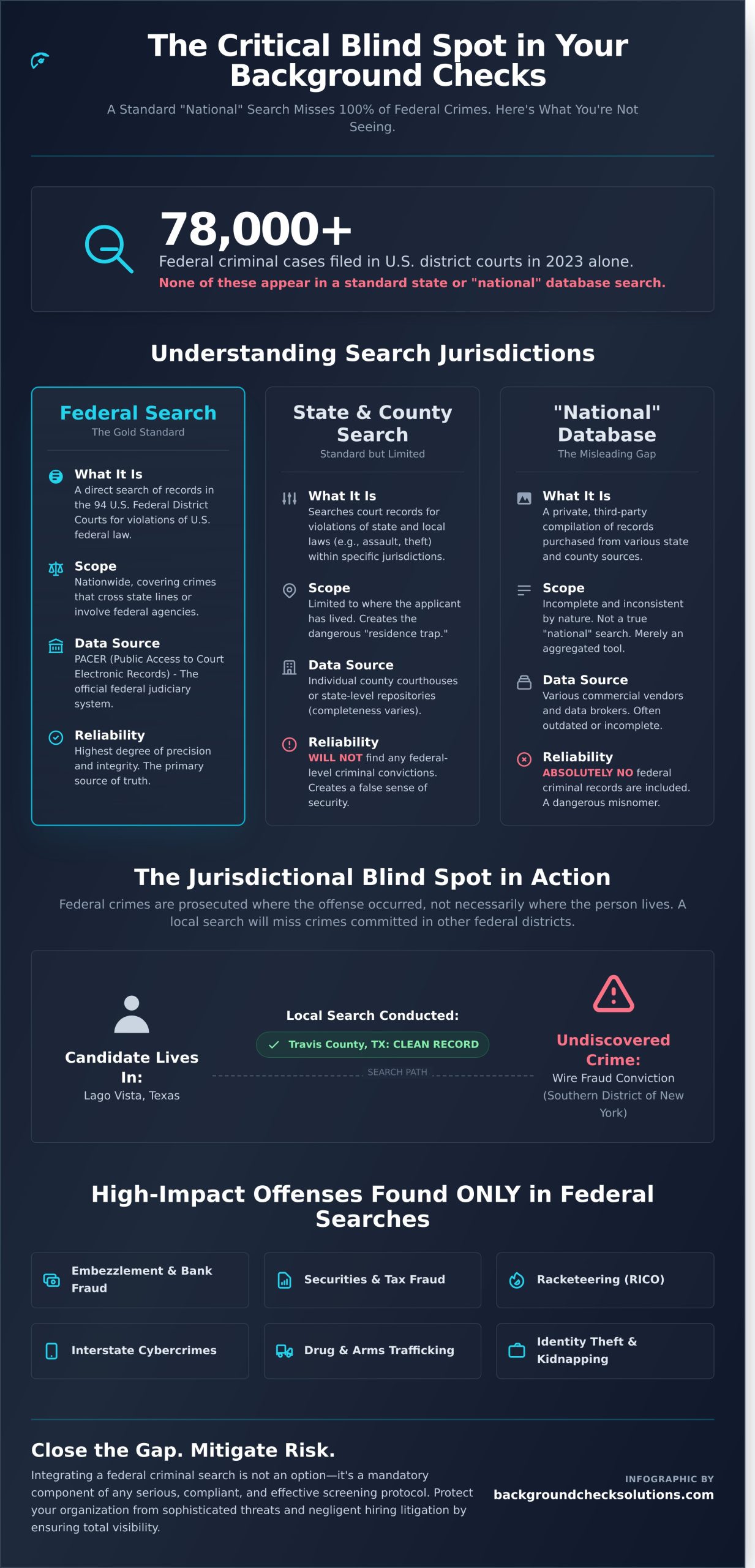
Over 78,000 criminal cases were filed in U.S. district courts in 2023, yet a standard national criminal database search won’t find a single one. It’s a startling gap, and you’re right to be concerned about the significant risks it represents, from sophisticated financial fraud to multi-jurisdictional crimes that fall outside state and county court systems. This blind spot isn’t just a process inefficiency; it’s a direct threat to your organization’s security and regulatory standing, potentially exposing you to negligent hiring litigation.
This guide is engineered to close that gap permanently. We will demystify the federal court system and provide a clear, actionable framework for integrating a comprehensive federal criminal search into your screening protocol, ensuring you mitigate risk and achieve total FCRA and EEOC compliance. By the end, you’ll have the confidence that no major criminal history was overlooked, safeguarding your company’s assets and reputation. You’ll learn to distinguish federal from national records, navigate the court hierarchy, and implement a streamlined process for confident, compliant hiring.
Key Takeaways
- Understand the critical distinction between federal and state criminal records to eliminate a common but significant gap in your screening process.
- Discover which high-impact offenses, such as embezzlement, securities fraud, and racketeering, are exclusively prosecuted in federal courts.
- Master the compliant process for conducting a federal criminal search, including how to identify all relevant U.S. District Courts for a thorough investigation.
- Evaluate how a professional screening partner streamlines complex multi-district searches to mitigate risk and ensure comprehensive due diligence.
What is a Federal Criminal Search and Why Does it Matter?
In the complex architecture of the U.S. justice system, criminal records are not stored in a single, unified database. A critical distinction exists between state and federal jurisdictions, and overlooking this division can expose an organization to significant risk. While state and county checks uncover violations of local laws, a federal criminal search targets offenses prosecuted by the United States government. These are often high-stakes crimes that indicate a level of sophistication and intent that is particularly concerning for employers in positions of trust. Because these records are housed in a completely separate judicial infrastructure, a standard background screening package will fail to uncover them, creating a critical visibility gap for hiring managers.
Understanding this distinction isn’t just a matter of compliance; it’s a fundamental component of a comprehensive risk mitigation strategy. A candidate with a clean state record could still have a history of serious federal offenses, including embezzlement, tax evasion, or interstate cybercrimes. Failing to conduct a proper federal search means you are making hiring decisions with incomplete, and potentially misleading, information.
The Scope of Federal Jurisdiction
Federal jurisdiction is triggered when a crime violates U.S. federal statutes, involves federal agencies, or crosses state or national borders. The specific offenses that fall under this authority are extensive, covering everything from bank robbery and kidnapping to securities fraud, as detailed in the legal framework for Federal crime in the United States. These cases are not tried in your local Lago Vista municipal court; they are adjudicated in one of the 94 U.S. District Courts. Each of these federal districts maintains its own records, and there is no central repository that aggregates them for public consumption. This structural separation is precisely why federal records remain invisible to state-level inquiries. A federal search is the process of querying specific U.S. District Courts for violations of federal statutes.
Common Misconceptions: National vs. Federal
The term “National Criminal Database” is one of the most persistent misnomers in the background screening industry. These databases are typically private compilations of records purchased from various state and county jurisdictions. While they can be a useful preliminary tool, they are not comprehensive and, most importantly, they do not contain federal criminal records. Federal litigation information is siloed within the federal judiciary’s own system, primarily the Public Access to Court Electronic Records (PACER) service. Relying on an “instant” national check for a high-stakes position, such as a CFO or IT administrator, is a dangerous gamble, as it completely bypasses this critical and distinct source of information.
Federal vs. State and County Criminal Searches
A comprehensive background screening strategy requires a clear understanding of jurisdictional boundaries. Crimes are not prosecuted in a single, unified system; they are adjudicated in separate legal arenas with distinct record-keeping protocols. State and county courts handle violations of local laws, such as theft, assault, and most drug possession charges. Federal courts, on the other hand, prosecute crimes that violate United States federal law. These offenses often cross state lines or involve federal agencies and include crimes like bank robbery, embezzlement, identity theft, and drug trafficking.
The operational differences are stark. A county search typically involves accessing records from a specific courthouse where an applicant has resided. A state search may pull from a centralized repository, but its completeness can vary. A federal criminal search operates differently, querying records across the 94 U.S. federal judicial districts. Because these systems don’t overlap, relying solely on a local search creates a significant, and often costly, gap in due diligence.
Jurisdictional Blind Spots
An applicant can present a perfectly clean county-level record while concealing a serious federal felony. This occurs because federal crimes are prosecuted where the offense took place, which is often not where the individual lives. This “residence trap” means a standard 7-year county search based on an applicant’s address history would completely miss a conviction filed in another district. For instance, an applicant in Lago Vista could be convicted of wire fraud prosecuted by the Southern District of New York if the victimized financial institution was based there, a fact that a Travis County search would never uncover.
Data Integrity and Verification
Federal records offer a higher degree of precision and reliability. Our researchers directly access the Public Access to Court Electronic Records (PACER) system, which provides real-time docket information straight from the source. This direct access minimizes the risk of outdated or incomplete information often found in third-party aggregated databases. In contrast to a broad but sometimes imprecise National Criminal Database Search, a federal check requires exact personal identifiers to confirm a match, ensuring FCRA compliance and mitigating the risk of false positives.
The investment in a layered screening approach delivers a clear return. While a direct federal search might take 24-72 hours to complete, the certainty it provides is invaluable. The incremental cost of adding a federal criminal search to a standard package is negligible when measured against the potential damage of a negligent hiring lawsuit or internal fraud. The Association of Certified Fraud Examiners’ 2022 report found the median loss per occupational fraud case was $117,000. Understanding these critical distinctions allows you to fortify your screening protocol against sophisticated risks and protect your organization’s assets and reputation.
Types of Offenses Uncovered in a Federal Criminal Record
While state and county records reveal a wide spectrum of local violations, federal criminal records expose an entirely different class of offenses. These are crimes that violate United States federal law, and they are prosecuted by U.S. Attorneys in federal district courts. Because the jurisdiction of these courts is specific, a standard background check limited to state and local databases will not access these critical records. These cases are adjudicated within a distinct legal framework, detailed in the Department of Justice’s Introduction To The Federal Court System, which includes 94 federal judicial districts across the country. A comprehensive federal criminal search is the only precise method for identifying these high-level risks.
The offenses documented in federal records are typically complex, often spanning multiple states or involving significant financial or public safety implications. They represent a severe breach of law and trust that is fundamental for any employer to identify. Key categories include:
- High-Level Drug Trafficking and Racketeering: This includes large-scale narcotics distribution, money laundering, and organized crime activities prosecuted under statutes like the Racketeer Influenced and Corrupt Organizations (RICO) Act.
- White-Collar and Financial Crimes: These are sophisticated schemes such as embezzlement from federally insured banks, tax evasion investigated by the IRS, securities fraud prosecuted by the SEC, and bankruptcy fraud.
- Crimes on Federal Property or Against Federal Officials: Any crime committed in a national park, a federal courthouse, or a military installation falls under federal jurisdiction, as do assaults or threats against federal employees, including postal workers and FBI agents.
- Interstate Cybercrimes and Identity Theft: When computer crimes or identity theft schemes cross state lines or target federal systems, they become federal offenses, often involving violations of the Computer Fraud and Abuse Act.
White-Collar and Financial Risk
Financial institutions and corporate entities regulated by bodies like the SEC and FINRA prioritize the federal criminal search because it uncovers sophisticated financial misconduct that local checks cannot. A conviction for wire fraud or insider trading, for instance, is a disqualifying event under FINRA Rule 4530. Such a federal conviction directly impacts an individual’s professional licensing eligibility and their ability to be bonded, creating an unacceptable compliance and liability risk for the hiring organization.
Public Safety and Institutional Risk
Beyond financial threats, federal records identify severe public safety risks. These include convictions for interstate weapons trafficking, terrorism-related offenses investigated by the Joint Terrorism Task Force, and crimes against the government like large-scale mail or Social Security fraud. These offenses demonstrate a capacity to exploit or endanger major public systems. Federal crimes often represent higher-level, premeditated offenses compared to impulsive local misdemeanors, indicating a more calculated threat to an organization’s security and integrity.
Conducting a Federal Search: Process and Compliance
Executing a federal criminal background check is a meticulous process that demands precision, legal awareness, and a deep understanding of the court system’s structure. Unlike a consolidated state or national database, federal records are decentralized across 94 U.S. federal judicial districts. A compliant and accurate federal criminal search requires identifying and querying the correct jurisdictions based on where an applicant has lived, worked, or potentially committed an offense. This isn’t a simple keyword search; it’s a targeted investigation into primary source court records.
The process begins by using an SSN Trace to establish a candidate’s 7-year address history, the standard reporting period under the Fair Credit Reporting Act (FCRA). Each address is then mapped to its corresponding federal district. The search is executed either directly through the Public Access to Court Electronic Records (PACER) system or, more efficiently, through a professional screening partner who can access these records and apply advanced verification methods.
Interpreting the findings is a critical step where expertise matters. A raw court file can be confusing, but every employer must understand three key components:
- Disposition: This is the final outcome of a charge. It could be “Guilty,” “Dismissed,” “Acquitted,” or another legal resolution. A “Dismissed” case, for instance, cannot be used as the basis for an adverse hiring decision in most circumstances.
- Counts: A single case can contain multiple charges, or “counts.” An applicant might face three counts of wire fraud but be found guilty on only one, with the other two dismissed as part of a plea agreement. You must evaluate only the count with a conviction.
- Sentencing: This details the penalties imposed for a conviction, such as incarceration time, fines, or probation. The severity and nature of the sentence are crucial for assessing relevance to the job role.
Step-by-Step Search Execution
A successful search hinges on a methodical approach that our technology and human expertise facilitate. Cross-referencing an applicant’s address history with the correct federal districts is the foundational step. Because federal records often lack personal identifiers like a date of birth, human-led verification is essential to analyze potential matches and eliminate false positives. This is particularly true when managing the “no middle name” challenge, as federal dockets frequently omit this key identifier, increasing the risk of misidentifying an individual.
Legal Compliance and Adverse Action
If a federal criminal search reveals a conviction, your review process must align with both FCRA and Equal Employment Opportunity Commission (EEOC) guidelines. Before making a decision, employers should apply the EEOC’s “Green Factors” from its April 25, 2012 enforcement guidance. This involves an individualized assessment that considers:
- The nature and gravity of the offense.
- The time that has passed since the offense or completion of the sentence.
- The nature of the job held or sought.
This assessment ensures your decision is job-related and consistent with business necessity. If you are considering adverse action based on these findings, you must follow the FCRA’s strict two-step notification process, which guarantees the applicant has the right to review the information and dispute any inaccuracies. The complexity of this process underscores the value of a knowledgeable partner. Ensure your federal searches are accurate and compliant by partnering with our FCRA-certified team.
Why Professional Federal Screening is the Reliable Choice
Understanding the distinction between federal and state records is only the first step; acting on that knowledge is what protects your organization. The decentralized nature of the federal court system, with its 94 distinct judicial districts, makes a manual search impractical and fraught with risk. An incomplete background check can expose your company to significant liability, from negligent hiring litigation to brand damage. To truly mitigate these risks, a professional and comprehensive federal criminal search isn’t just an option; it’s a corporate necessity.
Background Check Solutions streamlines this complex process by leveraging a proprietary network that accesses federal court records directly. We consolidate data from all 94 districts, ensuring a comprehensive nationwide search that an in-house team simply cannot replicate efficiently. This specialized data is delivered through a flexible, pay-per-report model. You don’t need a costly subscription for a search you may only run on executive-level candidates or specific roles. This transaction-based approach grants you access to high-level due diligence precisely when you need it, making it a cost-effective tool for targeted risk management.
The true value of professional screening is realized when it’s integrated into a holistic program. A federal offense record on its own provides a critical piece of the puzzle, but it doesn’t tell the whole story. We facilitate the seamless integration of federal data into a single, easy-to-read report that can also include:
- State and county criminal records
- Employment and education verifications
- Motor vehicle records
- Civil litigation history
This consolidated view provides the complete context necessary for confident decision-making, ensuring no stone is left unturned. Our commitment is to deliver not just data, but verified, actionable intelligence with industry-leading turnaround times, often within 24 to 48 hours for federal inquiries. This blend of accuracy and speed, all performed in strict compliance with the Fair Credit Reporting Act (FCRA), provides the regulatory peace of mind that decision-makers require.
The Background Check Solutions Advantage
Our system queries over 8,000 databases, eliminating the jurisdictional gaps that can hide critical information. Beyond technology, our team of U.S.-based researchers provides expert interpretation of complex federal dockets, translating convoluted legal records into clear, concise reports. While a federal check is vital for identifying high-level crimes, a truly comprehensive strategy also includes a meticulous County Criminal Search to cover potential local-level offenses.
Secure Your Hiring Process Today
With over 40 years of industry experience, we have become a trusted partner in protecting corporate integrity. Our straightforward, no-subscription model means you only pay for the services you use, removing budgetary barriers to thorough screening. Don’t leave your company’s safety to chance. Protect your business with a comprehensive Federal Criminal Search and build a foundation of trust from day one.
Fortify Your Screening Process and Mitigate Federal-Level Risk
Understanding the critical distinction between federal and local background checks is the first step toward comprehensive risk management. A standard screening process often overlooks serious offenses prosecuted in federal courts, like financial fraud and kidnapping, creating a dangerous compliance gap. This oversight can expose your organization to significant financial and reputational damage.
A professional federal criminal search isn’t an optional add-on; it’s an essential component of a diligent screening strategy. Since 1982, Background Check Solutions has empowered employers and landlords to mitigate this specific risk by providing direct access to primary source data from all 94 U.S. District Court databases. Our model is built for your efficiency: you pay only for the data you need, with no monthly or annual fees to complicate your budget.
Don’t leave your organization’s security vulnerable to incomplete data. Take the definitive step toward complete due diligence. Order a Precise Federal Criminal Search Today and protect your assets, your people, and your reputation with confidence.
Frequently Asked Questions
Is a federal criminal search the same as a national criminal background check?
No, a federal criminal search is distinct from a national criminal background check. Our federal search queries records directly from the 94 U.S. federal district courts, targeting crimes prosecuted under federal law. A national check, conversely, scans a broad but often incomplete database of state and county records. For a truly comprehensive screening process that mitigates all jurisdictional risks, both search types are essential components of your due diligence protocol.
How far back does a federal criminal search go?
A federal search has no predefined lookback period, but its reporting is governed by the Fair Credit Reporting Act (FCRA). Under the FCRA, federal convictions can be reported indefinitely. However, non-conviction information, such as dismissals or acquittals, is limited to a seven-year reporting window for employment screening. This ensures you receive the most extensive, legally permissible history to facilitate informed hiring decisions while maintaining full compliance.
What specific crimes show up on a federal criminal report?
A federal criminal report details offenses that violate United States federal law, which are often investigated by agencies like the FBI, DEA, or IRS. These crimes frequently involve interstate activity or federal institutions. Specific examples include bank robbery, tax evasion, counterfeiting, mail fraud, and drug trafficking across state lines. Identifying these severe offenses is critical for protecting your organization from significant financial and reputational liability.
Do federal criminal searches include state-level misdemeanors?
No, federal criminal searches do not include state-level misdemeanors or any offenses prosecuted in state or county courts. The federal and state judicial systems operate independently, maintaining separate record repositories. To identify state-level crimes, such as a DUI or simple assault, a targeted county or statewide criminal records search must be conducted. A multi-jurisdictional approach is the only way to ensure complete coverage.
How long does it typically take to get results from a federal search?
Results for a federal search are typically delivered within one business day. Our platform’s direct integration with the federal court’s Public Access to Court Electronic Records (PACER) system allows for this exceptional turnaround time. In rare cases where manual retrieval from a specific courthouse is required, the process may take up to 72 hours. We streamline data acquisition to ensure your hiring timeline proceeds without unnecessary delays.
Why should I run a federal search if the applicant has never lived near a federal court?
An applicant’s physical address is not an indicator of where a federal crime may have been committed or prosecuted. Federal offenses, such as wire fraud or crimes occurring on federal land, are adjudicated in the district where the crime took place. Overlooking a federal search based on an applicant’s address history creates a critical vulnerability in your screening process, potentially exposing your organization to unforeseen risks associated with white-collar crime.
Can I run a federal criminal search on myself?
Yes, you are permitted to run a federal criminal search on yourself to review the contents of your own record. This proactive step is useful for ensuring the accuracy of your information before applying for employment or a professional license. Utilizing a professional service like ours for a self-check ensures you receive a clear, comprehensive report and can address any discrepancies before they impact a third-party screening process.
Are federal criminal records public information?
Yes, the vast majority of federal criminal records are public information, accessible through the PACER system. This access is foundational to judicial transparency. However, in specific situations, such as cases involving national security or the protection of minors under 18, a judge may order a record to be sealed from public view. Our technology efficiently navigates these public records to provide verified, actionable intelligence for your screening needs.
Comments are closed.