Tenant Background Check: The Definitive Landlord’s Guide for 2026
March 10th, 2026 by Dodie
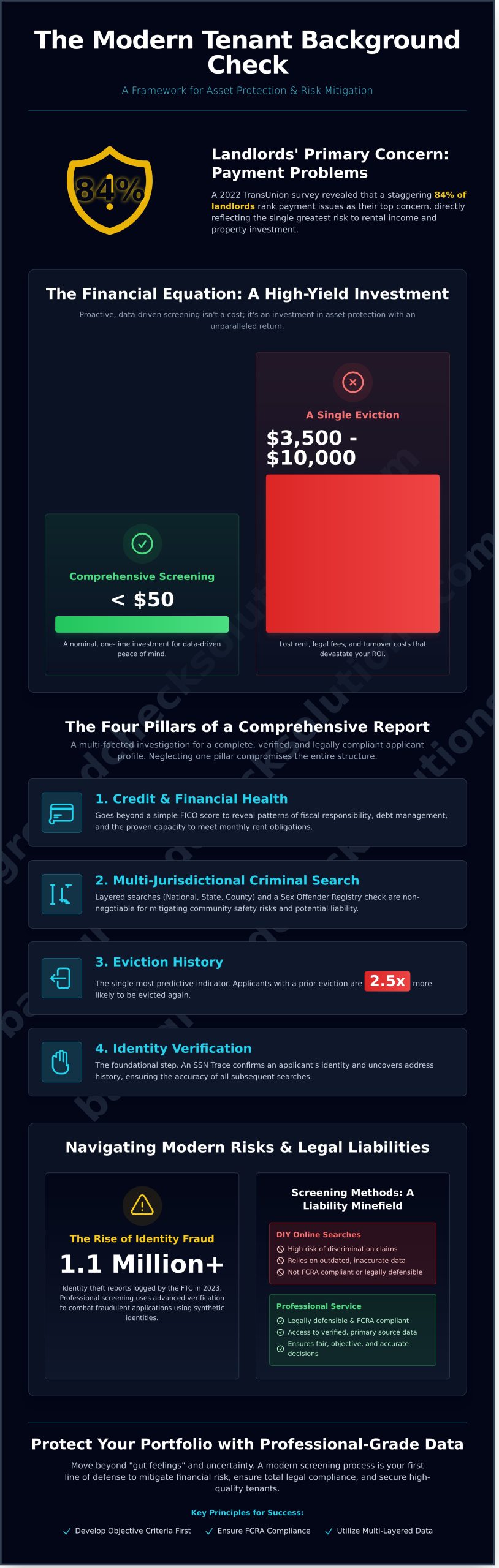
A 2022 TransUnion survey revealed that 84% of landlords rank payment problems as their primary concern. This isn’t just a statistic; it’s a direct reflection of the single greatest risk to your rental income and property investment.
It’s a reality every property owner understands. The line between a profitable asset and a costly liability is often determined by the person holding the keys. This definitive guide is engineered to move you beyond that uncertainty, providing a clear framework to master every facet of the modern tenant background check. You’ll learn how to mitigate financial risk, ensure total legal compliance, and ultimately protect your portfolio with professional-grade data.
We will dissect the critical components of a comprehensive screening process, from navigating complex FCRA requirements to identifying the most precise data sources, all without the burden of hidden subscription fees or unnecessary overhead.
Key Takeaways
- Understand why modern risk assessment for 2026 requires evaluating more than just a FICO score, incorporating multi-layered data for a complete financial and character profile.
- Navigate the complexities of the Fair Credit Reporting Act (FCRA) to ensure your screening process is both legally compliant and built on verified, accurate data.
- Develop clear, objective rental criteria before running a tenant background check to streamline your decision-making and mitigate potential litigation risks.
- Discover how a transactional, pay-per-report screening model can protect your return on investment by eliminating the hidden costs associated with subscription-based platforms.
Table of Contents
- Understanding the Critical Role of Tenant Background Checks in 2026
- The Four Pillars of a Comprehensive Tenant Screening Report
- Navigating Legal Compliance and Data Accuracy Standards
- How to Analyze Background Check Results for Risk Mitigation
- Why a Transactional, No-Fee Screening Model Protects Your ROI
Understanding the Critical Role of Tenant Background Checks in 2026
In the property management landscape of 2026, the tenant screening process has evolved far beyond a cursory glance at a credit score. It’s now a multi-layered risk assessment protocol, essential for safeguarding your investment in an increasingly volatile economic environment. A simple FICO score, once the gold standard, no longer provides the complete financial narrative required to make a secure leasing decision. It fails to account for recent income instability, eviction histories, or potential criminal activity that directly impacts your property and community safety.
Consider the stark financial equation. The cost of a comprehensive tenant background check is nominal, typically under $50 per applicant. Contrast this with the cost of a single eviction, which, according to 2024 landlord-tenant court data, averages between $3,500 and $10,000 when factoring in legal fees, lost rent, and property turnover expenses. This disparity underscores a fundamental truth: proactive, data-driven screening isn’t a cost; it’s a high-yield investment in asset protection. Furthermore, the very presence of a mandatory, professional screening process acts as a powerful deterrent, discouraging high-risk applicants from ever submitting an application and saving you invaluable time and resources.
The Evolution of Rental Risk Mitigation
The era of leasing based on “gut feelings” has definitively closed, replaced by a mandate for objective, data-driven decisions. This shift is driven by two critical factors: the rise of sophisticated identity fraud and the legal imperatives of fair housing. The Federal Trade Commission logged over 1.1 million identity theft reports in 2023 alone, and fraudulent rental applications using synthetic identities are a growing threat. A professional screening service utilizes advanced verification tools that a standard credit pull simply doesn’t, ensuring the person applying is who they claim to be.
Professional Screening vs. DIY Online Searches
Attempting to conduct your own applicant investigations using social media or free public record websites is a liability minefield. Such methods not only expose you to potential discrimination claims under the Fair Housing Act but also rely on data that is frequently outdated or inaccurate. A professional service streamlines the entire tenant screening process by accessing verified, primary source data directly from credit bureaus and courthouse records. This ensures that your leasing decisions are based on information that is compliant, current, and legally defensible, providing the peace of mind that DIY searches can never guarantee.
The Four Pillars of a Comprehensive Tenant Screening Report
A superficial glance at an application provides insufficient data to mitigate risk. A truly effective tenant background check is not a single search; it’s a multi-faceted investigation built upon four distinct yet interconnected pillars. Each pillar provides a unique lens through which to assess an applicant’s reliability, ensuring that your leasing decision is based on a complete, verified, and legally compliant picture. Neglecting even one of these components exposes your property and your business to significant financial and reputational liabilities.
The structural integrity of your screening process depends on the meticulous examination of these four areas:
- Credit History and FICO Scores: This pillar evaluates an applicant’s financial discipline and their capacity to meet monthly rent obligations. It goes beyond a simple score to reveal patterns of fiscal responsibility.
- Multi-Jurisdictional Criminal Searches: A comprehensive criminal history provides critical insight into an applicant’s past behavior, safeguarding your property and community. This requires more than a single database query.
- Eviction History: Past rental performance is the single most predictive indicator of future behavior. A 2023 analysis by the National Apartment Association confirmed that applicants with a prior eviction filing are over 2.5 times more likely to be evicted again.
- Identity Verification: The foundational step is confirming the applicant is who they claim to be. An SSN Trace validates their identity and uncovers address history, which is essential for ensuring the accuracy of all subsequent searches.
Deep Dive into Criminal Records
A National Criminal Database search is an essential starting point, accessing over 8,000 municipal, county, and federal sources. However, it cannot be the final word. True due diligence requires layering this search with state and county-level checks to uncover records that may not be indexed in the national database. Including a Sex Offender Registry search is also a non-negotiable step for mitigating community safety risks and potential liability. It’s vital to understand the difference between arrests and convictions in a report; only convictions are typically permissible for use in housing decisions. This distinction is a cornerstone of proper FCRA compliance for landlords and is critical for avoiding discrimination claims.
Credit Reports and Financial Stability
A FICO score isn’t just a number; it’s a story of financial reliability. For the rental industry, a score below 670 often signals a higher risk profile. We help you interpret this data, identifying “Red Flag” patterns such as recent bankruptcies, active civil judgments, or tax liens that indicate financial distress. But a credit check is incomplete without its necessary companion: employment verification. This final step confirms an applicant’s stated income and employment status, ensuring their debt-to-income ratio aligns with your property’s requirements. Ensuring each of these pillars is accurately represented requires a specialized approach; you can review our sample reports to see how we structure this data for clear, actionable insights.
Navigating Legal Compliance and Data Accuracy Standards
Executing a tenant background check is not merely a procedural step; it’s a regulated action governed by a complex web of federal and state laws. The primary legal framework is the Fair Credit Reporting Act (FCRA), a federal law that dictates how consumer information can be collected, accessed, and used. A professional pay-per-report service operates with FCRA compliance at its core, mitigating your legal exposure and ensuring that every report is both ethically sourced and legally defensible. This commitment to compliance is your first line of defense against costly litigation.
The allure of “instant” results from low-cost screening tools presents a significant legal liability. These automated systems often pull from outdated, aggregated databases, a practice that can lead to catastrophic errors. For instance, a common name can easily result in a false positive, incorrectly linking your applicant to someone else’s criminal record. The Consumer Financial Protection Bureau (CFPB) received over 700,000 complaints about inaccuracies in credit and consumer reports in 2021 alone, underscoring the pervasive problem of bad data. A qualified Consumer Reporting Agency (CRA) protects your interests by using human oversight and primary source verification to ensure the information you act upon is precise and current. Your peace of mind depends on this level of meticulousness.
Furthermore, handling an applicant’s Personally Identifiable Information (PII) demands robust security protocols. Professional screening firms invest heavily in protecting sensitive data like Social Security numbers and birth dates, employing security measures such as SOC 2 compliance and 256-bit AES encryption. This secure infrastructure isn’t a luxury; it’s a fundamental requirement for safeguarding applicant data and maintaining your professional integrity.
The Adverse Action Process
If a background check reveals information that leads to a rental denial, you must follow a strict, legally mandated procedure known as the Adverse Action process. This isn’t optional. Failing to comply can lead to significant penalties. The process ensures applicants have the opportunity to review and dispute the information, which is a critical component of Fair Housing laws and helps prevent claims of “disparate impact” discrimination against protected classes.
Data Integrity and Source Verification
Professional CRAs ensure data integrity by accessing information directly from its origin, such as municipal and county courthouses, rather than relying on third-party databases. This active verification prevents the use of “stale data,” where an old charge that has since been dismissed or expunged might incorrectly influence your decision. In a criminal record, the “Disposition” is the final outcome or settlement of the charge. Relying on verified, primary-source data for every tenant background check is the only way to guarantee you are making decisions based on the complete, accurate truth.
How to Analyze Background Check Results for Risk Mitigation
Receiving a comprehensive report is only the first step; the true value lies in a systematic and objective analysis. A disciplined evaluation framework is what transforms raw data into actionable intelligence, ensuring you not only select reliable tenants but also maintain full compliance with the Fair Housing Act. The foundation of this process must be established long before you review a single application: a clear, written set of rental criteria applied uniformly to every candidate.
Your established criteria should directly reflect your property’s specific risk tolerance. For a Class A property, your policy might require a minimum FICO score of 700 and a verified gross monthly income of 3.5 times the rent. For another portfolio, a score of 640 and a 3x income-to-rent ratio may be perfectly acceptable. The critical component is not the specific numbers, but the fact that they are pre-defined and consistently applied. A professional tenant background check provides the verified data points necessary to measure each applicant against these precise, business-based standards.
A crucial part of the analysis involves weighing historical data appropriately. A single 30-day late payment on a credit card from four years ago is factually different from a pattern of delinquencies and collections within the last 18 months. Similarly, the relevance of criminal records must be assessed based on the nature and age of the offense, adhering strictly to local and federal “look-back” period regulations. Your objective is to identify current behavioral patterns that predict future reliability, not to disqualify candidates for long-resolved issues that demonstrate no evidence of repetition.
Effective risk mitigation demands a “total picture” approach, where you balance credit, criminal, and eviction data to form a holistic view of the applicant. A lower credit score resulting from medical debt from three years prior, for example, might be offset by a pristine rental history and stable, long-term employment. Conversely, a high income doesn’t erase the significant risk presented by a recent eviction filing for non-payment. According to a 2022 TransUnion survey, 84% of landlords agree that a comprehensive screening is vital for this exact reason. No single data point tells the whole story.
Identifying High-Risk Red Flags
Certain data patterns serve as immediate high-risk indicators that require further scrutiny. These red flags include an unstable rental history showing three or more moves in under 24 months, material discrepancies between application claims and verified data (such as a 20% income overstatement), or any eviction filed within the last three years. An outstanding monetary judgment from a previous landlord is one of the strongest predictors of future default and must be addressed directly.
Developing a Consistent Scoring System
A standardized scoring system is your primary defense against allegations of housing discrimination. This internal framework must clearly define the objective criteria for “Accept,” “Decline,” and “Conditional Approval.” A conditional offer, such as requiring a qualified co-signer for an applicant with a thin credit file, provides a structured, compliant path for marginal candidates. It’s imperative that every decision, particularly any adverse action, is meticulously documented, tying the outcome directly to your pre-established rental criteria.
Implementing and managing such a detailed evaluation for every applicant requires precision and unwavering consistency to mitigate legal exposure. Let our tailored screening solutions help you develop and apply a consistent, defensible framework for every applicant.
Why a Transactional, No-Fee Screening Model Protects Your ROI
For landlords and property managers, maximizing return on investment isn’t just a goal; it’s the foundation of a sustainable business. Subscription-based screening platforms often erode this foundation with hidden costs. These services frequently require monthly fees, setup charges, and long-term contracts, forcing you to pay for access even during months with zero vacancies. An independent landlord with a single property might pay hundreds of dollars over a year for a service they use only once, fundamentally compromising their profitability.
A pay-per-report model is the most financially sound and strategically astute solution. It aligns your expenses directly with your operational needs, ensuring you only invest in screening when an application is pending. This transactional approach eliminates the financial drain of recurring fees for unused services, a critical advantage for independent landlords whose vacancy rates can fluctuate. You gain access to professional-grade tools without the enterprise-level overhead, allowing for precise budget control and a clear, predictable cost per applicant.
Moreover, the quality of the data is paramount. A significant risk in modern property management is the transient nature of applicants. An individual with an eviction or criminal record in one state can easily apply for a rental in another. Our screening process mitigates this risk by providing comprehensive, national reach. We access primary-source data from all 50 states, ensuring that an applicant’s history doesn’t disappear when they cross a state line. This level of diligence is essential for a truly effective tenant background check.
Background Check Solutions facilitates this professional-grade screening without demanding long-term commitment. We empower you with the same precise, FCRA-compliant data trusted by the nation’s largest property management corporations, delivered through a simple, on-demand platform. This model ensures your capital is allocated to protecting your assets, not to subsidizing a platform’s overhead.
Tailored Solutions for Every Property Type
Whether you manage a single-family home or a multi-unit corporate portfolio, our platform scales to your precise needs. You can customize each report to include specialized searches such as Motor Vehicle Records (MVR), employment and education verifications, or federal sanctions and watch list checks. Every report is backed by our 40+ years of industry expertise, providing you with the peace of mind that comes from meticulously verified information and unwavering compliance.
Getting Started with Professional Screening
Initiating a comprehensive screening is a streamlined, efficient process designed to save you time. Our system ensures rapid turnaround times, a crucial factor when a vacant property is costing you potential income each day. By accelerating the qualification process with reliable data, you can fill vacancies faster with highly qualified tenants. Protect your investment with a comprehensive tenant background check from Background Check Solutions and secure your property today.
Secure Your 2026 Rental Portfolio with Confidence
The rental landscape is evolving. Protecting your investment in 2026 requires a diligent screening process that moves beyond surface-level credit inquiries. A comprehensive tenant background check is your primary tool for mitigating risk, but its value is directly tied to its legal compliance and data accuracy. Adherence to FCRA standards isn’t optional; it’s the foundation of a defensible and profitable property management strategy. By adopting a transactional screening model, you ensure every dollar spent directly contributes to securing a reliable tenant, not to sustaining unnecessary platform fees.
Don’t leave your asset’s security to chance. Partner with an industry leader trusted by landlords since 1982. We provide direct access to over 8,000 municipal, county, state, and federal databases to deliver the professionally verified, FCRA-compliant reports you need for total peace of mind. Make your next placement decision with the highest degree of confidence. Order a professional tenant background check today; there are no monthly fees or sign-up costs. Secure your investment for 2026 and beyond.
Frequently Asked Questions
How long does a tenant background check usually take?
Most reports are delivered in under 60 seconds. Components like credit reports and national eviction searches are often instantaneous. However, a comprehensive criminal search that requires manual verification at a county courthouse can extend the turnaround time to 24-72 hours. This ensures the accuracy and compliance of the data, providing you with verified information to facilitate a confident and timely leasing decision. Delays are rare but necessary for precision.
What shows up on a tenant criminal background check?
A tenant criminal background check reveals felony and misdemeanor convictions sourced from a network of local, state, and national databases. The report typically includes the offense date, the nature of the crime, the disposition date, and the sentence. Our searches also scan the National Sex Offender Public Website and global watchlists, such as the OFAC list, to provide a comprehensive risk profile and help you maintain a secure property.
Can a landlord run a background check without the applicant’s consent?
No, a landlord cannot legally run a background check without securing explicit, written consent from the applicant. This is a strict requirement under the Fair Credit Reporting Act (FCRA). Obtaining a signed authorization form is a mandatory first step in the screening process. This protocol protects both the landlord from litigation and the applicant from unauthorized access to their personal information, ensuring the entire process remains compliant and transparent.
Does a tenant background check include an eviction history search?
Yes, a comprehensive tenant background check absolutely includes a detailed eviction history search. This search scours over 36 million state and county-level court records to identify prior unlawful detainers, monetary judgments, and failure-to-pay-rent filings. Examining an applicant’s eviction history is a critical step in mitigating financial risk and assessing their reliability, as past rental behavior is a strong predictor of future performance.
What is the difference between a soft pull and a hard pull on a credit report?
A soft pull does not affect an applicant’s credit score, while a hard pull can lower it by several points. Tenant screening services exclusively use a soft pull, as it’s a consumer-initiated inquiry that allows you to view credit information without impacting the applicant’s score. Hard pulls are typically reserved for when a consumer applies for a new line of credit, like a mortgage or auto loan. Using a soft pull ensures a positive applicant experience.
How far back do tenant background checks typically go?
Tenant background checks generally have a seven-year lookback period for most records, in accordance with FCRA guidelines. This includes civil judgments, collection accounts, and arrests that didn’t lead to a conviction. However, criminal convictions can be reported indefinitely in most states. Bankruptcies are reported for 10 years. These timeframes are designed to provide relevant, actionable data while adhering to federal and state reporting regulations.
What should I do if a tenant background check comes back with a criminal record?
If a report reveals a criminal record and you intend to deny the applicant, you must follow the FCRA’s two-step adverse action process. First, you send a pre-adverse action notice, which includes a copy of the report and a summary of their rights. You must then wait a reasonable period, typically 5 business days, for them to dispute inaccuracies. If you proceed, you send a final adverse action notice confirming your decision.
Are landlords required to provide a copy of the background check to the tenant?
Yes, you’re required to provide a copy of the report if you take any adverse action based on its contents. This includes denying their application, requiring a co-signer, or charging a higher security deposit. Under the FCRA, the applicant has a right to see the information that led to the decision. Providing the report and a summary of their rights allows them to verify the data’s accuracy and dispute any potential errors directly with the reporting agency.
Comments are closed.