The Definitive Guide to Professional Background Checks in 2026
March 9th, 2026 by Dodie
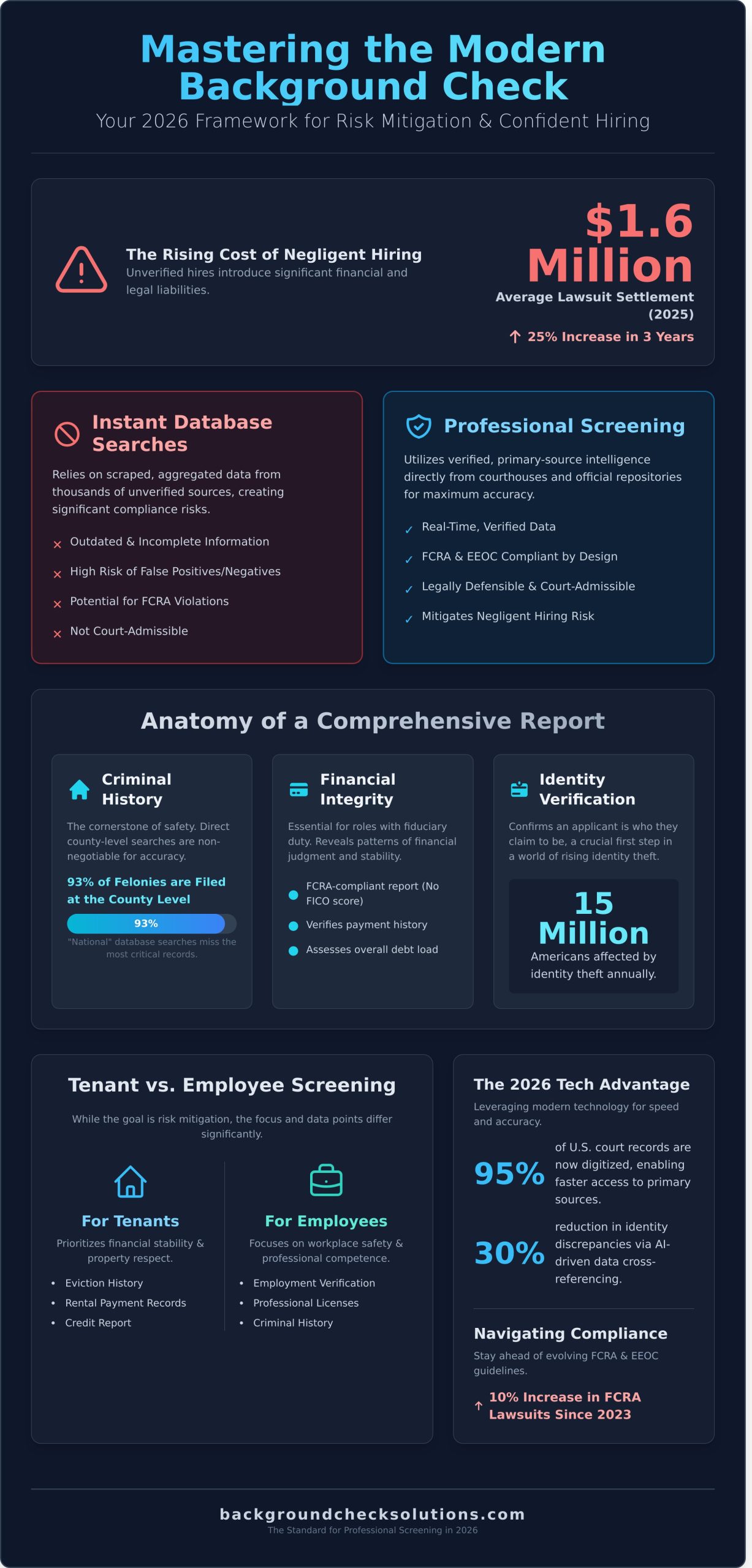
According to a 2025 analysis by the Professional Background Screening Association (PBSA), negligent hiring lawsuits resulted in an average settlement of $1.6 million, a 25% increase from just three years prior. It’s a figure that confirms what many HR leaders and property managers already feel: the stakes have never been higher. You’re caught between the urgent need for fast, decisive action and a labyrinth of conflicting state and federal regulations that can stall your entire process, leaving you exposed to significant risk.
This guide is engineered to provide clarity and control. We will equip you with the precise strategies needed to master the complexities of the modern background check, ensuring you can protect your assets, guarantee regulatory compliance, and make hiring or leasing decisions with absolute confidence. From leveraging primary-source data for court-admissible accuracy to streamlining your workflow for sub-24-hour turnarounds, we’ll outline the definitive framework for risk mitigation in 2026.
Key Takeaways
- Distinguish between aggregated data from instant databases and the verified, primary-source intelligence that defines a professional screening report.
- Uncover the dangerous assumption behind “national” searches and learn how to close critical data gaps at the local level to mitigate negligent hiring risks.
- Navigate the evolving legal landscape by understanding the 2026 updates to FCRA and EEOC guidelines, ensuring your hiring process remains fully compliant.
- Learn to implement a modern background check program that balances advanced technology with human expertise to protect your assets and ensure peace of mind.
What is a Background Check? Defining the 2026 Standard
A professional background check is the systematic, compliant process of verifying an individual’s history to mitigate future risk for an organization. It’s a foundational security measure that extends far beyond the superficial results of a consumer-grade “people search.” While a simple web search scrapes publicly available, often unverified data, a professional screening service accesses primary source information directly from county courthouses, federal repositories, and national credit bureaus. This distinction is crucial; for a deeper understanding of the practice, an overview of what a background check entails provides a comprehensive foundation.
The screening landscape of 2026 is defined by two powerful forces: advanced AI and near-universal digital record-keeping. With over 95% of U.S. court records now digitized, access is faster than ever. However, this accessibility introduces complexity. AI-driven platforms now intelligently filter and cross-reference millions of data points, flagging inconsistencies that would elude manual review and reducing identity-related discrepancies by up to 30% compared to legacy systems. This technological leap makes the “DIY” Google search not just insufficient but a significant legal liability. Relying on unverified search results can expose a company to data from protected classes and inaccurate information, creating a direct path to discrimination claims and costly FCRA litigation, where lawsuits have increased by over 10% since 2023.
The Core Components of a Comprehensive Report
A truly comprehensive report is not a single search but a mosaic of verified data points. Each component provides a unique layer of insight into an applicant’s reliability and integrity.
- Criminal History: This is the cornerstone of any safety-conscious screening process. We differentiate between a national database search, which is a valuable preliminary tool, and direct county-level searches. Since approximately 93% of all felony and misdemeanor cases are filed and stored at the county level, this direct approach is the only way to ensure a complete and accurate criminal record.
- Financial Integrity: For roles with fiduciary responsibility, a credit report is indispensable. While FCRA-compliant employment reports don’t include a FICO score, they reveal crucial patterns of financial behavior, such as payment history and debt load, which are direct indicators of an individual’s stability and judgment.
- Identity Verification: In an era where identity theft affects over 15 million Americans annually, robust identity verification is non-negotiable. An SSN Trace establishes a history of names and addresses associated with a Social Security Number, creating a foundational record that confirms an applicant is who they claim to be.
Tenant vs. Employee Screening: Key Differences
While the objective of risk mitigation is universal, the focus of a tenant screening report differs substantially from that of an employment screening. A tailored solution is essential for gathering relevant, actionable intelligence for each specific need.
For landlords in Lago Vista, the primary concerns are an applicant’s ability to pay rent consistently and respect the property. Therefore, a tenant screening prioritizes eviction history and rental payment records. For employers, the focus shifts to professional competence and workplace safety. An employment screening meticulously verifies past employment dates, job titles, and any required professional licenses or credentials. Despite these different data points, the shared goals remain clear: to secure a reliable, financially stable individual who contributes positively to the environment, whether it’s a residential community or a corporate team.
The Anatomy of a Professional Screening Report
Not all background checks are created equal. A consumer-grade, instant search often scrapes outdated, aggregated databases, delivering a report riddled with potential inaccuracies and compliance risks. Understanding the components of a comprehensive professional screening report is the first step for Lago Vista employers aiming to mitigate hiring risks effectively. A truly professional report is built upon layers of verified, primary source data, not just a surface-level digital sweep.
The core difference lies in the data’s origin. Aggregated databases compile information from thousands of sources, but they often lag in updates, leading to false positives or, more dangerously, missed records. A professional background check relies on primary source verification, meaning we access records directly from the courthouse or government agency where they were originally filed. This distinction is critical for maintaining compliance with the Fair Credit Reporting Act (FCRA).
This commitment to accuracy directly impacts the timeline. While an instant database query returns results in seconds, a meticulous verification process involving manual court runners dispatched to a specific county courthouse, like the one in Travis County, typically requires a 24 to 72-hour turnaround. This measured approach ensures the information you receive is current, accurate, and legally reportable. Once the data is retrieved, interpreting the findings is paramount. A “disposition” is the final resolution of a criminal charge. A candidate may have a record showing an arrest, but the disposition could be “dismissed” or “acquitted.” Understanding this context is essential for making fair and defensible hiring decisions.
Criminal Records: Navigating 8,000+ Databases
A comprehensive criminal history requires a multi-jurisdictional search strategy, as no single database contains all criminal records. Our process systematically queries thousands of sources to build a complete picture.
- The National Criminal Database: This serves as a broad initial net, cross-referencing a candidate’s information against a proprietary database compiled from sources across multiple states. It’s an effective tool for identifying potential records outside a candidate’s known address history, but any “hit” found here must be verified at the primary source before it can be reported.
- County Criminal Searches: This is the gold standard for accuracy. The vast majority of felony and misdemeanor crimes are prosecuted at the county level. A direct search of courthouse records in counties where a candidate has lived provides the most reliable and up-to-date information on convictions and pending cases.
- Federal Criminal Searches: These searches uncover crimes prosecuted by the U.S. government in federal district courts. These offenses, such as bank fraud, tax evasion, or interstate trafficking, will not appear in a county or statewide search, making this a critical component for financial and executive-level roles.
Specialized Verifications for High-Stakes Roles
For certain positions, standard criminal searches are insufficient to fully mitigate risk. Tailored verifications are non-negotiable for roles involving vulnerable populations, financial assets, or company liability.
- Sex Offender Registry: A search of the National Sex Offender Registry is a mandatory due diligence step for any role in property management, healthcare, education, or childcare.
- Terrorist Watch List (OFAC): This compliance search checks against global sanctions lists, including the Office of Foreign Assets Control (OFAC). It’s a legal requirement for financial institutions and a best practice for any organization to ensure they are not engaging with specially designated nationals.
- Driving Records (MVR): An MVR check is essential for any employee who will operate a company vehicle. It reveals license status, violations, and restrictions, directly impacting your organization’s insurance rates and liability exposure.
In addition to verifying the driver, protecting the vehicle itself is a key part of managing that liability. As an example of comprehensive security, Safe & Sound Mobile offers nationwide installation of advanced vehicle security systems in the UK.
Constructing the right screening package requires a deep understanding of both legal requirements and role-specific risks. To ensure your process is both compliant and comprehensive, our experts can help you design a tailored screening solution that protects your business and community.
National vs. Local Searches: Why Scope Matters
A common, and dangerous, misconception in employment screening is that a “national” criminal search canvases every courthouse in the United States. It does not. No single, government-maintained national criminal database exists for commercial use. Instead, these searches query a patchwork of privately compiled databases, which pull information from a variety of sources at different intervals. According to a 2023 industry analysis by the Professional Background Screening Association (PBSA), these databases can miss up to 25% of county-level criminal records, creating a critical blind spot for employers and a false sense of security.
This data gap stems from the fragmented nature of record-keeping. Thousands of county and municipal jurisdictions across the country update and report their data on different schedules. Some may upload records quarterly, while others don’t report to commercial databases at all. An assault conviction from 60 days ago in a non-reporting county simply won’t appear. Relying solely on this incomplete picture is a direct path to negligent hiring litigation, where an employer can be held liable for the actions of an employee whose history they failed to properly investigate.
The only way to ensure total coverage is through strategic layering. A comprehensive background check isn’t about choosing national or local searches; it’s about leveraging the strengths of both. The process begins with a national database scan to provide broad, immediate insight. This is the breadth. We then use that initial data, combined with a Social Security Number (SSN) Trace, to identify every county the applicant has resided in over the past seven years. Finally, we dispatch researchers to conduct direct, primary-source searches at each of those county courthouses. This is the depth, and it’s where true diligence is proven.
Consider a case from Q4 2023 involving a healthcare provider in the Austin metro area. The national search for a nursing candidate came back clear. However, our SSN Trace identified a prior two-year residency in a rural Florida county. The direct county court search we initiated uncovered a conviction for felony prescription fraud that was entirely absent from the national database. That one local search prevented a catastrophic hire.
The Limitations of Database-Only Checks
So-called “instant” reports are built on data that is often outdated by the time it reaches you. Because of reporting lags, these databases can be 30 to 90 days behind real-time court records. Furthermore, automated systems frequently produce false positives based on common names. Our analyst-driven verification process confirms personal identifiers like date of birth to eliminate these errors, ensuring every report is accurate and compliant with federal law. It’s crucial that employers understand the regulations governing this process, as outlined in the Summary of Your Rights Under the FCRA provided by the Consumer Financial Protection Bureau. While a cheap, instant search may seem cost-effective, a single negligent hiring lawsuit can result in settlements exceeding $1 million, making the initial savings tragically insignificant.
Verifying History in a Mobile Society
In an economy where the average employee changes jobs every 4.1 years, candidates often have a multi-state residential history. An SSN Trace is the foundational tool for a reliable screening process, creating a roadmap of where to search by revealing an applicant’s address history. This allows us to target county-level searches with precision. For candidates with frequent relocations, this multi-jurisdictional approach is non-negotiable. We also ensure the screening process includes a search of all known names and aliases, such as maiden names, to close any potential loopholes and deliver a complete, verified history for your peace of mind.
Regulatory Compliance: Navigating the FCRA in 2026
Conducting a legally sound background check is not merely a procedural step; it is a foundational component of risk mitigation. The Fair Credit Reporting Act (FCRA) serves as the primary federal statute governing this process, establishing a strict framework for how consumer reporting agencies collect information and how employers and landlords use it. Failure to adhere to these regulations doesn’t just create administrative headaches; it exposes your Lago Vista organization to significant legal and financial liability.
The regulatory landscape is not static. Looking ahead, compliance demands an understanding of evolving interpretations and guidelines. For example, the Equal Employment Opportunity Commission (EEOC) is projected to release updated guidance effective January 1, 2026. This update is expected to mandate that employers perform and document a more rigorous “individualized assessment” for any applicant with a criminal conviction less than seven years old. This shift intensifies the employer’s burden to prove a direct link between a past offense and the specific duties of the job, making a standardized, one-size-fits-all disqualification policy exceptionally risky.
When a report’s findings lead you to consider denying an applicant employment or housing, you must initiate the “Adverse Action” process. This is a non-negotiable, two-step procedure mandated by the FCRA.
- Step 1: Pre-Adverse Action Notice. Before making a final decision, you must provide the applicant with a notice. This package must include a copy of the background report that influenced your decision and a copy of “A Summary of Your Rights Under the Fair Credit Reporting Act.”
- Step 2: Waiting Period & Final Notice. After sending the pre-adverse notice, you must wait a reasonable period, typically five to seven business days, to allow the applicant time to review the report and dispute any inaccuracies with the reporting agency. If you proceed with the denial after this period, you must send a final Adverse Action Notice, which formally states your decision and provides details of the consumer reporting agency used.
Ultimately, absolute transparency and a well-documented process that respects applicant rights are the most robust defenses against litigation. A clear, compliant policy demonstrates good faith and significantly reduces your legal exposure.
The Permissible Purpose Requirement
An organization cannot run a background check on a whim. Under the FCRA, you must have a legally recognized “permissible purpose,” such as for employment screening, tenant applications, or credit eligibility. Crucially, you must obtain the applicant’s explicit written consent before initiating the check. This authorization must be presented on a clear, standalone document, not buried within a larger application form. Furthermore, all sensitive data obtained must be stored securely and disposed of properly, per the FTC’s Disposal Rule, to prevent unauthorized access.
State-Specific Nuances: Texas and Beyond
While the FCRA provides a federal baseline, state and local laws introduce additional layers of complexity. In Texas, for instance, landlord-tenant laws grant property owners significant latitude in using criminal histories for screening. However, the rise of “Ban-the-Box” ordinances in cities like Austin means employers in the Lago Vista area are restricted from asking about criminal history on initial applications. This legislative trend requires a multi-stage screening process. Navigating these jurisdictional differences, including varying “seven-year rules” on reporting non-conviction data, demands meticulous attention to detail. Ensuring your screening process is compliant with all federal, state, and local regulations is a complex task. Partner with our compliance experts to design a tailored screening solution that mitigates risk and ensures peace of mind.
Choosing a Screening Partner: The Pay-Per-Report Advantage
Selecting a partner for your screening needs in Lago Vista presents a critical choice between two distinct operational models: automated Software as a Service (SaaS) platforms and professional service firms. While SaaS providers offer instant, algorithm-driven results, they often deliver raw, unverified data that can create significant compliance risks. A professional service firm, conversely, integrates advanced technology with essential human oversight to transform that raw data into verified, actionable intelligence. This distinction is crucial for any organization committed to mitigating risk and making sound hiring or tenancy decisions.
At Background Check Solutions, we’ve structured our entire service around the principle that human expertise is indispensable. Technology is a powerful tool for data aggregation, but it cannot interpret the nuances of a court record or navigate the complexities of Fair Credit Reporting Act (FCRA) compliance on its own. Our model ensures that every report is handled by professionals who understand the legal landscape, providing you with the clarity and peace of mind that automated systems simply can’t guarantee.
No Monthly Fees: The ROI of Pay-Per-Report
For small businesses and independent landlords, the financial burden of subscription-based screening can be substantial. Many “low-cost” monthly plans obscure their true expense with setup charges, minimum usage requirements, or additional fees for essential data access. A transaction-based, pay-per-report model eliminates this financial uncertainty and provides a clear return on investment. You gain complete control over your budget by paying only for the precise services you require, when you require them. This approach offers three foundational benefits:
- Calculated Costs: Without monthly retainers or hidden fees, your expenses directly correlate to your hiring or leasing activity. If you screen one applicant, you pay for one report. This direct cost-benefit relationship makes financial planning simple and predictable.
- Effortless Scalability: A pay-per-report structure inherently supports your growth. Whether your screening needs increase from two to twenty applicants a month, your process scales seamlessly without the need to renegotiate a contract or upgrade a costly subscription tier.
- Total Transparency: You select and pay for only the specific data points relevant to your needs. If you only require a local criminal history search for a position in Lago Vista, you don’t pay for a national database package you won’t use.
The Background Check Solutions Difference
Our commitment to providing a superior background check is rooted in a foundation of experience and integrity. Since 1982, Background Check Solutions has been a leader in the industry, developing a meticulous process that combines proprietary technology with decades of expertise. We provide direct access to primary-source data from over 8,000 municipal, county, state, and federal databases, ensuring the information you receive is timely and accurate.
What truly sets us apart, however, is our dedicated support. Our team doesn’t just deliver a report; we provide the context needed to understand it. We bridge the gap between complex data and confident decision-making, helping you maintain compliance and protect your assets. This synthesis of powerful technology and expert human analysis ensures you have a reliable partner dedicated to your security. Protect your business today with a comprehensive background check from Background Check Solutions.
Fortify Your Hiring Strategy for 2026 and Beyond
The 2026 hiring environment requires a higher standard of diligence. Successfully navigating complex FCRA regulations and understanding the critical scope of a search are foundational to mitigating organizational risk. This comprehensive approach is what defines a truly professional background check, transforming it from a procedural step into a strategic asset. Partnering with an established expert ensures you meet this standard with precision and confidence.
Since 1982, Background Check Solutions has provided landlords and employers with the tools for confident decision-making. We facilitate this by offering direct access to over 8,000 databases, delivering fully FCRA-compliant reports with no sign-up fees or subscription requirements. Order your pay-per-report background check now to streamline your hiring process and secure the peace of mind that comes from verified information.
Build your team with certainty.
Frequently Asked Questions About Background Checks
How long does a professional background check typically take in 2026?
A professional background check is typically completed within 24 to 72 hours. While our advanced platform automates over 85% of domestic criminal searches for completion in under one business day, certain factors can extend this turnaround time. Verifications requiring manual courthouse record retrieval or international searches may take up to five business days. Technology continues to streamline the process, but ensuring complete accuracy sometimes requires direct human oversight, which we provide to guarantee reliable results.
Is it legal to run a background check without the person knowing?
No, it is strictly illegal to run a background check for employment, housing, or credit purposes without the individual’s explicit written consent. Federal law, specifically the Fair Credit Reporting Act (FCRA), mandates that employers and landlords must provide a clear disclosure and obtain authorization before procuring a consumer report on a candidate. Failure to adhere to these compliance standards can result in significant legal penalties and litigation, making proper procedure a critical component of risk mitigation.
What is the difference between a Level 1 and Level 2 background check?
A Level 1 background check is a name-based search limited to state-level criminal history records, often conducted through a state’s department of law enforcement. In contrast, a Level 2 check is a more comprehensive, fingerprint-based screening that includes searches of state and national databases, such as the FBI’s Integrated Automated Fingerprint Identification System (IAFIS). Level 2 checks are mandated by Texas state law for individuals working with vulnerable populations, including roles in childcare, education, and healthcare.
Will a background check show arrests that did not lead to a conviction?
Yes, a background check can show arrest records, but federal and state laws regulate their reporting for hiring decisions. The FCRA generally prohibits consumer reporting agencies from reporting non-conviction arrest records that are more than seven years old. However, more recent arrests and pending criminal cases can appear. It’s essential to understand these nuances to ensure your hiring process remains compliant and fair to all applicants while still protecting your organization.
How far back do background checks go for employment and housing?
The standard lookback period for most information on a background check is seven years, a restriction primarily dictated by the FCRA for non-conviction data. However, this seven-year rule does not apply to criminal convictions, which can be reported indefinitely at the federal level, though some states have their own limitations. Furthermore, the seven-year reporting restriction is waived for positions with an annual salary of $75,000 or more, allowing for a more extensive review.
What should I do if a background check comes back with negative information?
If a background check contains adverse information that might impact your decision, you must follow the FCRA’s two-step adverse action process to remain compliant. First, provide the applicant with a pre-adverse action notice, a copy of the report, and the “A Summary of Your Rights” document. After allowing a reasonable time for a response, typically five business days, you may then issue a final adverse action notice if you decide not to proceed with the hire.
Can I use a background check to verify someone’s education and past job titles?
Yes, comprehensive screening packages are designed to verify a candidate’s stated qualifications, including education degrees, employment history, and professional licenses. With over 53% of resumes containing falsifications according to a 2023 Society for Human Resource Management (SHRM) report, these verifications are a critical tool for mitigating hiring risks. Our team directly contacts institutions and former employers to confirm the accuracy of a candidate’s credentials, ensuring you hire with confidence.
How much does a standard background check cost for a small business?
For a small business, a standard pre-employment background check typically costs between $25 and $75 per candidate. The precise cost is determined by the scope of the search; a basic package covering a Social Security Number trace and a national criminal database search is at the lower end of this range. More comprehensive reports that include county-level searches, motor vehicle records, and employment or education verifications will fall into the higher end of the pricing spectrum.
Comments are closed.