Eviction History Report for Landlords: A Complete Guide (2026)
February 26th, 2026 by Dodie
The financial and operational strain of a problematic tenancy-particularly one involving a “professional tenant” adept at exploiting legal loopholes-represents one of the most significant risks to a landlord’s investment. Navigating this risk requires a meticulous, data-driven screening process, and a critical component of this strategy is the comprehensive eviction history report for landlords. This tool is designed to provide a clear, factual record of an applicant’s rental past, but simply possessing this data is insufficient; a nuanced understanding of its contents and legal implications is paramount to its effective use.
This complete 2026 guide is engineered to provide that clarity. We will dissect what an eviction report contains, delineate your legal obligations under the Fair Credit Reporting Act (FCRA), and provide actionable strategies to help you interpret these records accurately. By leveraging this information, you can mitigate the substantial risks of costly problem tenants, protect your investment, and confidently streamline your screening protocol to secure reliable occupants for your property.
Key Takeaways
- Recognize why an applicant’s past rental conduct is the single most accurate predictor of their future performance, making this report an indispensable risk mitigation tool.
- Learn to analyze the specific data points within an eviction report, moving beyond a simple pass/fail judgment to accurately assess the full context of a candidate’s history.
- Confidently integrate an eviction history report for landlords into your screening process by mastering the essential requirements of the Fair Credit Reporting Act (FCRA) to ensure full legal compliance.
- Develop a systematic, compliant screening protocol that leverages verified eviction data to effectively protect your real estate investments from the financial and operational risks of problem tenancies.
Why an Eviction History Report is a Landlord’s Most Critical Tool
In the landscape of property management, mitigating risk is paramount. While standard credit and criminal background checks provide a foundational layer of security, the single most effective predictor of a tenant’s future performance is their past rental behavior. An eviction history report for landlords offers precisely this insight. It is a detailed, verified record of an applicant’s history with formal legal eviction filings and judgments. This report moves beyond financial solvency to reveal a documented pattern of tenancy, providing a clear and objective measure of reliability.
What an Eviction Report Reveals That Other Checks Miss
A standard credit report may indicate financial distress, but it often fails to capture the full context of a tenant’s rental history. An eviction check illuminates critical gaps. For instance, it can uncover a pattern of lease violations unrelated to payment, such as property damage or unauthorized occupants. It is also the primary tool for identifying ‘professional tenants’ who exploit legal loopholes to delay payment. Crucially, because the process of Eviction in the United States can be lengthy, an eviction filing often appears long before a related debt is sent to collections and impacts a credit score, providing an indispensable early warning.
The True Cost of a Problem Tenant
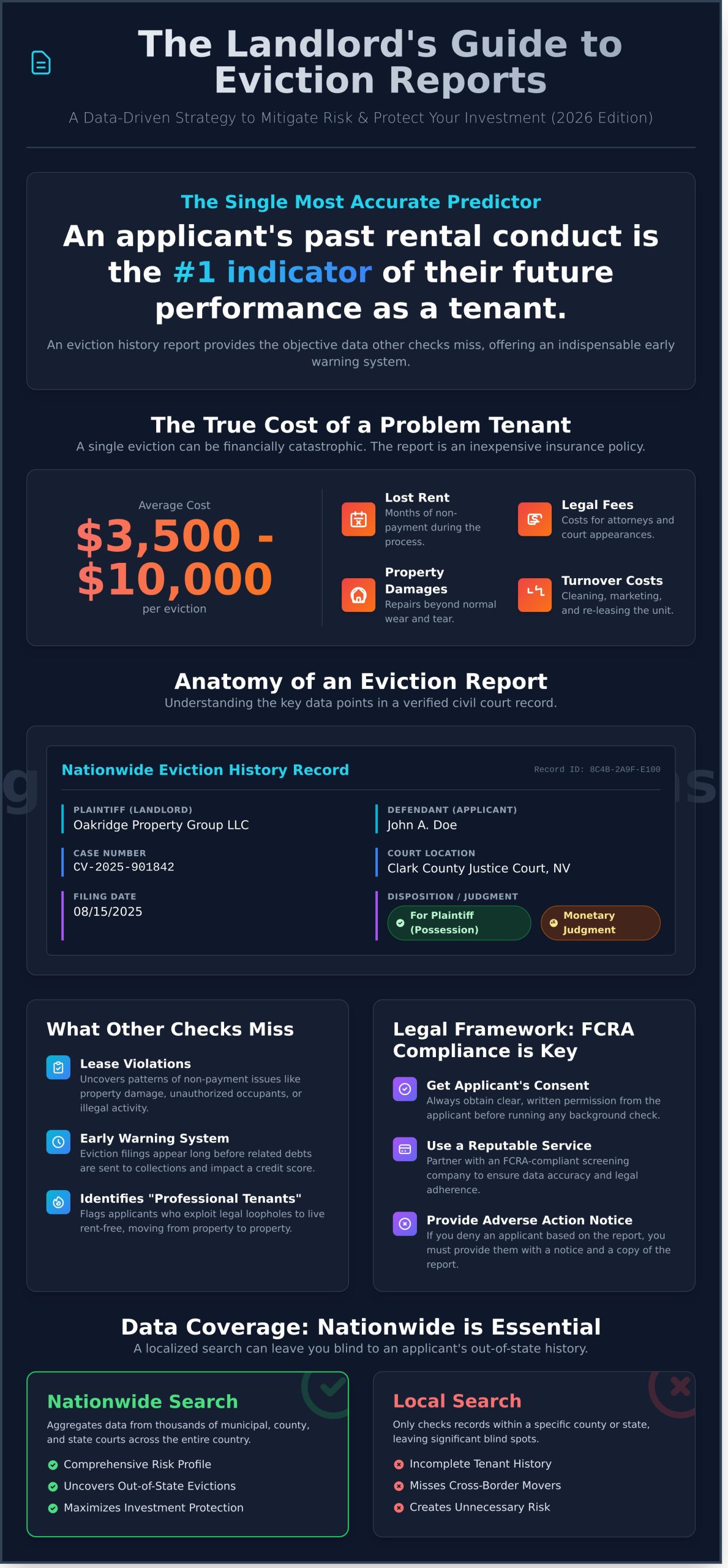
Placing a high-risk tenant can result in catastrophic financial consequences, with the average eviction costing between $3,500 and $10,000. This figure accounts for more than just court filings; it encompasses a range of direct and indirect expenses:
- Lost Rent: Months of non-payment during the eviction process.
- Legal Fees: Costs for attorneys and court appearances.
- Property Damages: Expenses for repairs beyond normal wear and tear.
- Turnover Costs: Time and resources spent cleaning, marketing, and re-leasing the unit.
A comprehensive eviction history report is an inexpensive insurance policy against these substantial losses. The ultimate return on this small investment is not merely financial protection but the invaluable peace of mind that comes from securing a reliable, long-term tenant for your property.
Anatomy of an Eviction Report: What Information You’ll Actually See
To effectively mitigate risk, property managers and landlords must understand the precise information contained within a tenant screening report. An eviction report is not a simple pass/fail assessment; it is a detailed summary of civil court records related to landlord-tenant disputes. It is crucial to recognize that these are official records of legal proceedings initiated by a property owner, not unverified complaints or informal disputes. A comprehensive eviction history report for landlords provides a transparent view into these legal proceedings, offering objective data to facilitate informed decision-making.
Key Data Points and Their Meanings
A detailed report presents several critical data points, each serving a distinct purpose in painting a complete picture of an applicant’s rental history. Understanding these components allows you to assess the severity and context of any past issues.
- Plaintiff and Defendant: Clearly identifies the landlord or property management company that filed the suit (Plaintiff) and the applicant (Defendant).
- Case Number and Court Location: Provides the official court-assigned number and jurisdiction for the case, ensuring the record is verifiable and traceable to its primary source.
- Filing Date: Indicates the date the eviction lawsuit was formally initiated, offering a timeline of events.
- Disposition/Judgment: Details the final outcome of the case. Common dispositions include a judgment for possession (the landlord won the right to reclaim the property), a monetary judgment (the tenant was ordered to pay a specific amount), or a dismissal (the case was dropped or settled).
Data Sources, Accuracy, and Coverage
The reliability of an eviction history report for landlords is directly tied to the quality and breadth of its data sources. Information is aggregated from thousands of municipal, county, and state court systems across the nation, which is why a nationwide search is fundamentally superior to a limited, county-level check. An applicant with a problematic rental history in another state would be missed entirely by a localized search.
The integrity of this data is non-negotiable. Reputable screening services pull information directly from primary court sources to build a comprehensive profile. Utilizing this data responsibly is paramount, as it falls under strict federal guidelines for FCRA compliance for landlords, which governs how consumer reports can be used in housing decisions. Partnering with a data provider that prioritizes direct access and near-real-time updates is essential for ensuring both accuracy and legal defensibility in your screening process.
How to Interpret Eviction Records: Red Flags vs. Context
Receiving an eviction history report for landlords that contains a record does not automatically necessitate a denial. The true value of this data lies in a methodical interpretation that separates minor issues from significant liabilities. A disciplined review process, grounded in a consistent policy, is essential to mitigate risk while ensuring fair and compliant tenant screening. It is also crucial to use multiple identifiers, such as date of birth and address history, to confirm the record belongs to your applicant, thereby preventing false positives associated with common names. This kind of data-driven process, built on accuracy and trust, is vital in many professional fields; for instance, a community-focused service like Sage Creek Pharmacy builds its reputation on providing personalized and reliable care, demonstrating the value of a trustworthy process in any professional relationship.
Eviction Filing vs. Eviction Judgment: A Critical Distinction
Understanding the legal terminology on a report is paramount. An eviction filing simply indicates that a landlord initiated the legal process. It is not a verdict of wrongdoing; the case could have been dismissed, withdrawn, or settled amicably. In contrast, an eviction judgment is a court’s final ruling in favor of the landlord. This is a significant red flag, as it confirms a legal determination that the tenant violated their lease terms.
A Landlord’s Checklist for Reviewing Eviction Data
To facilitate an objective assessment, your review of any eviction record should be guided by a standardized checklist. Developing this consistent internal policy is fundamental to Using Eviction Reports and Staying FCRA Compliant, as it ensures every applicant is evaluated against the same criteria. Consider the following factors:
- Frequency and Pattern: Is this a single, isolated filing from years ago, or does the report show a pattern of multiple filings across different properties? A recurring pattern suggests a higher risk.
- Recency of the Record: A judgment from the past year carries more weight regarding current financial stability than a decade-old case that may no longer be relevant.
- Monetary Judgment: Did the court award the previous landlord a monetary judgment for unpaid rent or property damages? This indicates a direct financial loss and is a primary risk indicator.
- Cross-Verification: Does the information on the report align with the residential history provided by the applicant? Discrepancies should be addressed directly.
By analyzing these details, you transform a simple data point from an eviction history report for landlords into actionable intelligence, allowing for a more precise and defensible leasing decision.
The Legal Framework: Using Eviction Reports and Staying FCRA Compliant
For many property managers, the primary concern surrounding tenant screening is not cost, but legal liability. This apprehension is understandable, yet it can be fully mitigated through a disciplined, compliant process. The use of an eviction history report for landlords is governed by federal law, specifically the Fair Credit Reporting Act (FCRA), which provides a clear framework for protecting both you and your applicants. Adherence to the FCRA is not optional; it is a strict requirement that can be managed effectively by following three distinct stages: obtaining consent, performing a review, and taking action.
Your Obligations Under the Fair Credit Reporting Act (FCRA)
Under the FCRA, an eviction history report is classified as a “consumer report,” which triggers specific legal duties for the end-user. To maintain compliance and protect your business from potential litigation, you must integrate the following non-negotiable steps into your screening protocol:
- Obtain Written Consent: You must inform the applicant in writing-in a standalone document-that a background check may be used in the decision-making process and get their explicit written authorization to proceed.
- Use a Compliant Partner: Partnering with a reputable, FCRA-compliant screening provider like Background Check Solutions is critical. We ensure the data you receive is sourced and reported in accordance with all applicable laws, transferring a significant portion of the compliance burden from you to us.
- Ensure Data Security: All information obtained must be kept confidential and stored securely. You have a legal responsibility to protect the applicant’s sensitive personal data from unauthorized access.
What Is ‘Adverse Action’ and How to Handle It Legally
Should the information in a report lead you to an unfavorable decision, you must follow the FCRA’s adverse action protocol. “Adverse action” is any decision that negatively impacts the applicant, such as denying their application, requiring a co-signer, or increasing the security deposit. If you take adverse action based wholly or partly on the findings in an eviction history report for landlords, you are legally required to provide the applicant with a specific notice. This notice must include the name and contact information of the screening company that provided the report and a statement informing the applicant of their right to obtain a free copy of the report and to dispute its accuracy. Navigating this process manually can introduce errors, but our system helps you streamline the adverse action process to ensure compliance.
Secure Your Investment with a Compliant Eviction History Report
Protecting your rental property is not merely about finding a tenant; it is about selecting the right one. Making an informed decision requires access to precise, comprehensive data that illuminates an applicant’s full rental, financial, and criminal background. At Background Check Solutions, we provide more than just data; we offer a strategic partnership in risk mitigation, empowering you to safeguard your investment with confidence and legal assurance. Our process is meticulously designed to deliver the critical insights you need to prevent costly evictions, property damage, and potential litigation.
For independent landlords and property managers, flexibility and cost-effectiveness are paramount. We have structured our services to meet this need directly. Our pay-per-report model eliminates the burden of subscriptions and monthly minimums, ensuring you only pay for the screening services you require. This approach provides access to enterprise-level data intelligence without the enterprise-level commitment, making a professional eviction history report for landlords both accessible and affordable.
Why Our Reports Provide a Complete and Compliant Picture
Our commitment to thoroughness is unmatched. We consolidate data from over 8,000 databases to deliver a nationwide report covering eviction records, criminal history, and a full credit assessment. Every report is processed through a platform engineered for full FCRA compliance, protecting you from legal challenges. With a legacy of trust as a primary data source since 1982, we provide the verified, accurate information necessary for you to make defensible leasing decisions.
How to Order Your First Eviction History Report
Initiating a comprehensive tenant screening is a straightforward and efficient process designed to facilitate quick decision-making. There are no setup fees or hidden costs-just transparent, per-report pricing. Our rapid turnaround times ensure you can secure qualified tenants without unnecessary delays.
- Create Your Account: Sign up in minutes on our secure, user-friendly platform.
- Request a Report: Enter the applicant’s information to initiate the screening process.
- Receive Comprehensive Results: Access the detailed report directly from your dashboard, often within the same business day.
By integrating a reliable and compliant eviction history report for landlords into your screening protocol, you actively fortify your investment against foreseeable risks. Take the decisive step to ensure the stability and profitability of your rental property. Protect your property today. Order a comprehensive tenant screening report.
Secure Your Investment with Diligent Tenant Screening
Navigating the complexities of tenant selection requires more than intuition; it demands precise, actionable data. As we have detailed, a comprehensive eviction history report for landlords is not merely a document but a fundamental component of your risk mitigation strategy. By learning to interpret the nuances within these records and, critically, adhering to the strict legal framework of the FCRA, you transform raw data into a powerful tool. This diligence empowers you to make leasing decisions that protect your assets, foster a stable rental environment, and ensure the long-term viability of your business.
For over four decades, Background Check Solutions has been the trusted partner for landlords seeking accuracy and compliance. Since 1982, we have provided direct access to over 8,000 national databases, delivering the detailed, verified information you need without the burden of monthly fees or subscriptions. Take the decisive step in safeguarding your property and investing in your peace of mind.
Order Your FCRA-Compliant Tenant Screening Report Now
Frequently Asked Questions
How far back does an eviction history report go?
The Fair Credit Reporting Act (FCRA) generally limits civil judgments, including evictions, to a seven-year reporting period. This ensures that landlords receive relevant, recent data for their risk assessment while adhering to federal compliance standards. Our reports are meticulously compiled to provide a comprehensive yet legally compliant seven-year history, giving you the critical information needed to make an informed decision without exposure to outdated, non-reportable data.
Can a landlord run an eviction check without the applicant’s permission?
No, a landlord must obtain explicit, written consent from a rental applicant before conducting any background screening, including an eviction check. This is a strict requirement under the Fair Credit Reporting Act (FCRA). Failing to secure proper authorization can lead to significant legal and financial penalties. Our platform facilitates this process by integrating compliant digital consent forms, ensuring you remain protected while streamlining your applicant screening workflow.
What should I do if an applicant disputes the information on their eviction report?
If an applicant disputes information, you must follow the adverse action process outlined by the FCRA. This involves providing the applicant with a copy of the report and a summary of their rights, allowing them to dispute the inaccuracy directly with the consumer reporting agency. We then conduct a thorough reinvestigation. It is imperative to pause the rental decision until the dispute is resolved to mitigate litigation risk and ensure fair housing compliance.
Does a ‘broken lease’ show up on an eviction history report?
A ‘broken lease’ itself does not typically appear on an eviction report unless it resulted in a formal legal action filed by the previous landlord. An eviction report specifically searches court records for unlawful detainer lawsuits or formal eviction judgments. If a tenant broke a lease and simply forfeited a security deposit without court intervention, that event would not be part of the public record and thus would not be included in the report.
How much does an eviction history report cost?
The cost of an eviction history report can vary based on the comprehensiveness of the search and the specific package selected. We offer tailored solutions to fit diverse operational needs and budgets, from standalone reports to integrated screening packages. We prioritize delivering high-value, verified data rather than competing on price alone. Please contact our team for a detailed consultation and a quote designed to meet your specific property management requirements.
Is it legal to have a policy of automatically denying anyone with an eviction record?
Implementing a blanket policy of automatically denying any applicant with an eviction record is legally precarious and strongly discouraged. Such policies can be challenged as discriminatory under the Fair Housing Act (FHA), as they may have a disparate impact on protected classes. The best practice is to evaluate each applicant holistically, considering the context, age, and outcome of the eviction as part of a consistent, non-discriminatory screening policy.
What’s the difference between your report and a cheap, instant online search?
The critical difference lies in data verification, compliance, and depth. Cheap, instant searches often pull from unverified, aggregated databases, leading to inaccuracies and potential FCRA violations. Our eviction history report for landlords is a comprehensive, FCRA-compliant screening tool that accesses primary source court records and is supported by our expert team. We deliver precise, actionable intelligence you can legally use to make decisions, providing peace of mind and mitigating your risk.
Comments are closed.