Landlord Credit Check on Tenant: A Complete Guide (2026)
February 24th, 2026 by Dodie
Navigating the tenant screening process can feel like traversing a legal minefield, where a single misstep can result in significant compliance liabilities. For property owners and managers, conducting a thorough landlord credit check on tenant is a foundational step in mitigating financial risk. However, the fear of inadvertently violating FCRA regulations, coupled with the challenge of deciphering complex credit data from an unreliable service, often makes this critical procedure seem both daunting and dangerously opaque. This uncertainty not only complicates applicant selection but also leaves your valuable investment exposed.
This definitive 2026 guide is engineered to eliminate that ambiguity and empower you with a clear, defensible methodology. We will meticulously detail our proven, three-step process for running a tenant credit check, from obtaining legally sound consent to accurately analyzing the report and making a final, compliant decision. By implementing this framework, you will gain the capability to swiftly identify high-risk applicants, ensure your operations adhere to all legal standards, and achieve the ultimate peace of mind that comes from protecting your assets with precision and confidence.
Key Takeaways
- Learn why obtaining explicit, lawful consent under the Fair Credit Reporting Act (FCRA) is a non-negotiable first step to mitigate legal risk.
- Develop objective screening criteria *before* you review any reports to ensure fair, consistent, and legally defensible decision-making.
- Master a compliant, three-step framework for conducting a landlord credit check on tenant, from gaining consent to making a final, legally sound determination.
- Discover how to take appropriate action-including approval, denial, or approval with conditions-while maintaining strict FCRA compliance.
Why a Tenant Credit Check is a Non-Negotiable Risk Management Tool
In the landscape of property management, proactive risk mitigation is paramount. A tenant credit check is not merely a procedural step; it is the foundational component of a diligent screening strategy designed to protect your investment. This report provides a comprehensive, verified overview of an applicant’s financial history and behavior, allowing you to assess their ability and likelihood to remit rent payments consistently and on time. Think of a tenant credit report as an applicant’s financial resume-it reveals patterns of responsibility that a simple application cannot. The nominal cost of this screening is insignificant when contrasted with the substantial financial and operational burdens of a problematic tenancy, which can include eviction proceedings, property damages, and months of lost revenue.
Dealing with property damages is a significant concern, and upgrading with durable, high-quality materials can be a wise long-term strategy. For instance, modernizing bathrooms or living spaces with custom glass features not only enhances appeal but can also be a resilient choice. For property owners in Utah, Jeske Glass provides custom frameless glass services that can elevate a property’s value and durability.
What a Standard Credit Check Reveals
A comprehensive landlord credit check on tenant applicants delivers far more than a single number. It provides a multi-faceted view of their financial standing, enabling a more informed leasing decision. Key data points include:
- FICO Score: A standardized snapshot of an applicant’s overall creditworthiness.
- Payment History: A detailed record of on-time payments, late payments, and delinquencies, which is a primary indicator of future reliability.
- Debt Load & Credit Utilization: An analysis of how much debt the applicant carries relative to their available credit, indicating their level of financial leverage.
- Public Records: Critical information regarding bankruptcies, civil judgments, and tax liens that could directly impact their ability to fulfill a lease agreement.
Credit Check vs. a Simple Application Form
While a rental application collects self-reported information, a credit check provides objective validation. This distinction is critical for establishing a screening process rooted in data, not intuition. A credit report facilitates a more robust evaluation by providing third-party verification of an applicant’s financial claims. This data-driven approach is a cornerstone of a fair and effective tenant screening process, ensuring every applicant is assessed against the same objective criteria. Implementing a consistent landlord credit check on tenant candidates mitigates risk and helps ensure compliance with fair housing regulations by standardizing your decision-making framework.
Step 1: Obtaining Lawful Consent Under the FCRA
Before a single piece of financial data is accessed, the process of conducting a landlord credit check on tenant must begin with a foundational legal step: obtaining explicit, written consent. This is not a procedural formality but a strict mandate governed by federal law. The entire framework for this requirement is detailed in the Fair Credit Reporting Act (FCRA), a piece of legislation designed to promote the accuracy, fairness, and privacy of consumer information. Failure to adhere to these regulations exposes landlords to significant legal and financial liabilities, transforming a routine screening into a substantial risk.
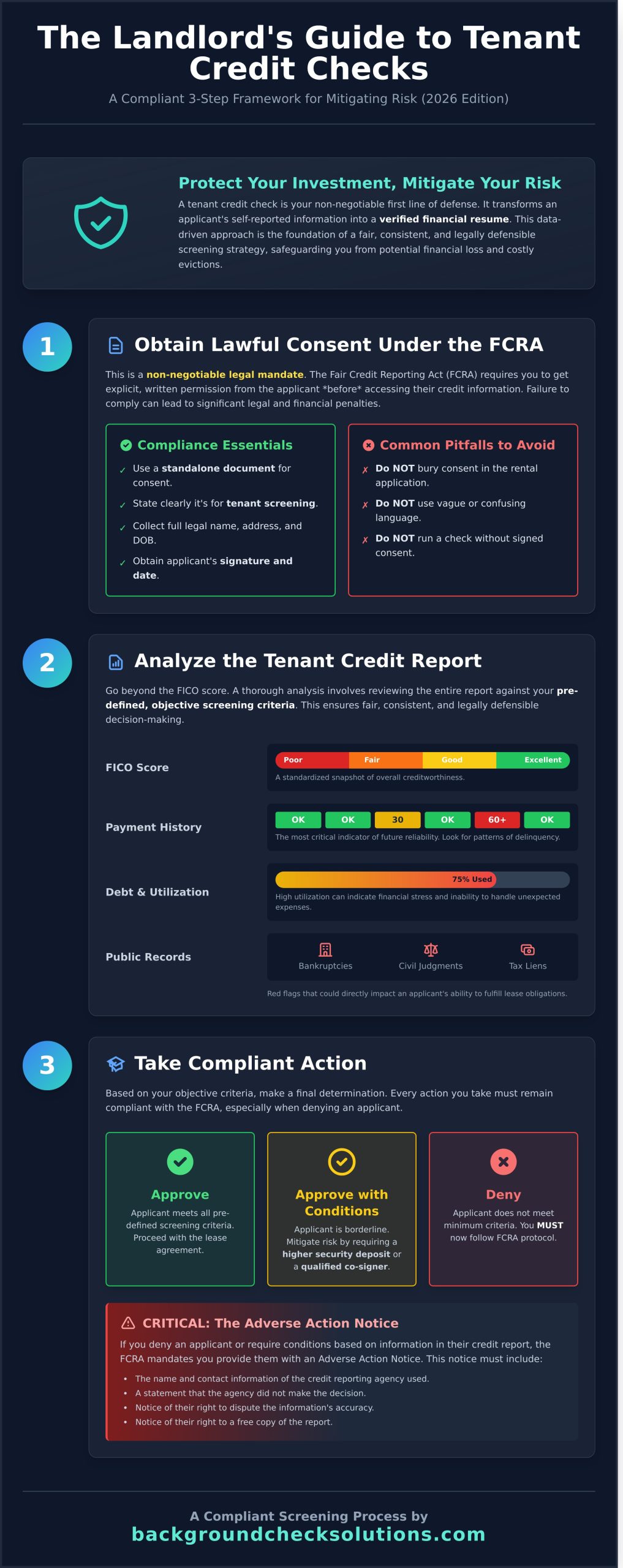
A critical component of FCRA compliance is that the applicant’s authorization must be provided in a clear, standalone document. It is a common yet non-compliant practice to embed a consent clause within the fine print of a multi-page rental application. To mitigate litigation risk, the consent form must be presented separately, ensuring the applicant knowingly and voluntarily provides permission specifically for the credit inquiry.
Essential Elements of a Consent Form
To ensure your authorization is legally sound, the document must be meticulously crafted. While tailored solutions may vary, every valid consent form should include the following core components to meet compliance standards:
- A clear and conspicuous statement authorizing you or your agent to obtain a consumer credit report for tenant screening purposes.
- The applicant’s full legal name, current address, and date of birth to ensure precise data retrieval.
- The applicant’s signature and the date the consent was provided.
Digital vs. Paper Consent
In today’s market, both traditional paper and digital consent forms are legally valid, provided they are executed correctly. Utilizing a professional tenant screening portal to obtain digital consent offers distinct advantages, as it streamlines the process and creates a secure, easily accessible audit trail. These platforms are designed to ensure compliance with the federal Electronic Signatures in Global and National Commerce (E-SIGN) Act, thereby facilitating a more efficient and secure method for managing and storing these critical documents.
Step 2: How to Analyze a Tenant Credit Report Like a Pro
Once you have the report, the real analysis begins. A successful landlord credit check on tenant applicants goes far beyond a cursory glance at the three-digit FICO score. To mitigate risk effectively, you must interpret the complete financial narrative. The most critical first step is to establish your minimum rental criteria before you begin reviewing applications. This practice ensures you apply the same standards to every applicant, which is fundamental for maintaining fairness and adhering to the FTC guidelines on tenant screening. Look for overarching patterns rather than isolated incidents; one late payment may be an oversight, but a consistent history of delinquencies signals a potential risk.
Key Sections and What to Look For
A thorough landlord credit check on tenant applicants involves a methodical review of several key areas. Each section offers a unique insight into financial responsibility, and you should cross-reference the information-such as previous addresses or listed debts-with the rental application to identify any inconsistencies.
- Payment History (The #1 Factor): This is the most significant component. Are there any accounts in collections, charge-offs, or payments reported as 60 or 90 days late? These are substantial indicators of past financial difficulty.
- Credit Utilization: High balances on revolving credit lines, such as credit cards, can suggest an individual is over-extended and may be experiencing financial distress, potentially impacting their ability to pay rent consistently.
- Public Records: This section reveals major financial events. A history of bankruptcies or, most critically, prior evictions filed with the court, should be considered significant red flags that warrant further investigation.
- Credit Inquiries: A large volume of recent hard inquiries could indicate that the applicant is seeking multiple new lines of credit, which may signal financial instability or desperation.
Understanding the FICO Score Ranges
While the full report provides context, the FICO score offers a standardized summary of credit risk. However, a lower score does not necessitate an automatic denial. It is crucial to investigate the underlying factors. For instance, significant medical debt is often viewed differently than defaulted consumer debt, as it is typically unplanned and does not necessarily reflect poor financial management.
- 800+ : Exceptional
- 740-799: Very Good
- 670-739: Good
- 580-669: Fair
Step 3: Taking Action and Maintaining FCRA Compliance
Once you have thoroughly analyzed the applicant’s credit and background report, the next step is to make a definitive, legally-sound decision. This decision, which must be based on legitimate business reasons directly related to your pre-established screening criteria, typically results in one of three outcomes: approving the application, denying the application, or approving the application with conditions, such as requiring a higher security deposit or a co-signer. The final step in a comprehensive landlord credit check on tenant is to execute this decision while meticulously maintaining legal compliance. This stage is critical for mitigating the risk of discrimination lawsuits.
If your decision to deny an applicant or impose stricter conditions is based, in whole or in part, on information contained within their consumer report, you are legally required by the Fair Credit Reporting Act (FCRA) to follow specific adverse action procedures.
What is an Adverse Action Notice?
An adverse action notice is a formal, written, oral, or electronic notification informing an applicant that you have taken a negative action based on information from their consumer report. This is not merely a courtesy; it is a federally mandated requirement designed to protect consumer rights. Issuing this notice correctly is a fundamental component of a compliant tenant screening process and demonstrates a commitment to fair housing practices.
Requirements for the Adverse Action Notice
To remain compliant with the FCRA, your adverse action notice must contain specific information. Failure to include these elements can result in significant legal and financial penalties. The notice must clearly provide the applicant with the following:
- A statement that the adverse action was taken based on information obtained in their consumer report.
- The full name, address, and phone number of the consumer reporting agency (CRA) that supplied the report.
- A statement that the CRA did not make the decision to take the adverse action and is unable to provide the specific reasons why the action was taken.
- Notice of the applicant’s right to obtain a free copy of their consumer report from the CRA if they request it within 60 days.
- Notice of the applicant’s right to dispute the accuracy or completeness of any information in the report with the CRA.
Navigating these regulatory requirements is paramount for protecting your business. Partnering with a professional screening provider like Background Check Solutions helps ensure every step of your landlord credit check on tenant, including the issuance of adverse action notices, is handled with precision and full compliance.
Streamline Your Screening with a Compliant, Pay-Per-Use Service
Navigating the legal intricacies of tenant screening, from obtaining proper consent to adhering to Fair Credit Reporting Act (FCRA) guidelines, can expose independent landlords to significant risk. A professional screening service automates these complex steps, providing a secure and efficient framework to mitigate liability. By leveraging a dedicated platform, you can ensure every landlord credit check on tenant is conducted with precision and full compliance, safeguarding your assets and your peace of mind.
Background Check Solutions provides comprehensive, reliable reports without the burden of monthly fees or subscriptions. Our process is meticulously designed for landlords, integrating applicant consent and adverse action tools directly into the workflow. In minutes, you receive a clear, easy-to-read report featuring a FICO score, detailed credit history, and other critical data points necessary for making an informed leasing decision.
The Background Check Solutions Advantage
Our platform is engineered to deliver accuracy, compliance, and unparalleled value for property owners. We combine advanced technology with decades of industry expertise to facilitate a superior screening process.
- FCRA-Compliant Platform: Our system features built-in, automated consent and adverse action workflows, which are essential for protecting you from potential disputes and litigation.
- No Membership Fees: Pay only for the reports you need. This pay-per-use model is ideal for independent landlords and property managers who require flexibility without a long-term financial commitment.
- Comprehensive Data: Access verified credit, criminal, and eviction histories from a trusted, primary data source, ensuring the information you receive is both thorough and up-to-date.
- Established Since 1982: With decades of experience, we have established a legacy of providing precise and reliable screening services that our clients depend on to protect their investments.
How to Order Your First Report
Initiating a professional landlord credit check on tenant is a straightforward, three-step process designed for maximum efficiency. Simply create your free account, which takes only a few minutes to set up. From your secure dashboard, you can invite your applicant to authorize the screening through an online portal. Once consent is provided, the comprehensive report is generated and delivered directly to your dashboard, empowering you to proceed with confidence.
Take the final step in securing your property and mitigating risk. Protect Your Investment and Order a Tenant Credit Check Today.
Secure Your Investment with a Compliant Screening Process
In today’s complex rental market, tenant screening is the cornerstone of responsible property management. As this guide has demonstrated, mitigating risk effectively requires a dual focus: first, obtaining lawful consent under the Fair Credit Reporting Act (FCRA), and second, analyzing the resulting report with professional diligence. A comprehensive landlord credit check on tenant provides the critical data you need, but its power is realized only through strict adherence to these legal and analytical standards.
Navigating these requirements demands a reliable partner. Since 1982, Background Check Solutions has provided landlords with fully FCRA-compliant processes and forms, empowering them to make informed decisions with confidence. Our pay-per-use service ensures you get precisely what you need without the commitment of monthly fees or subscriptions. Streamline your process and gain peace of mind by partnering with an industry leader.
Take the definitive step toward protecting your property. Order a Compliant Tenant Credit Check Today and build a foundation of trust and security with your next tenant.
Frequently Asked Questions
What is a good credit score for a tenant in 2026?
While specific benchmarks can evolve, a credit score of 670 or higher is consistently viewed as a strong indicator of financial responsibility. Landlords typically establish their own criteria, but a score in this range generally signifies a lower-risk applicant. Evaluating this data point is a critical step in mitigating potential defaults and ensuring the stability of your rental income. A comprehensive report provides the context needed to make an informed decision based on the applicant’s complete financial history.
Can a landlord run a credit check on a tenant without their permission?
No, a landlord cannot legally run a credit check on a prospective tenant without their explicit, written consent. This requirement is mandated by the Fair Credit Reporting Act (FCRA) to protect consumer privacy. Obtaining a signed authorization form is a non-negotiable step in the screening process. Proceeding without this consent constitutes a serious compliance violation, exposing the landlord to significant legal and financial penalties. Ensuring proper authorization is fundamental to a lawful screening protocol.
How long does a landlord credit check typically take?
With modern, integrated platforms, the turnaround time for a landlord credit check is nearly instantaneous. Once the applicant provides the necessary consent and information, our streamlined system accesses primary source data to generate a comprehensive report within minutes. This efficiency accelerates the decision-making process, allowing landlords to secure qualified tenants quickly and reduce vacancy periods. The swift delivery of accurate data is essential for maintaining a competitive edge in the rental market.
Does a tenant credit check hurt their credit score?
The impact on a tenant’s credit score depends on the type of inquiry used. A “hard inquiry,” typically initiated by the landlord, can cause a minor, temporary dip in the applicant’s credit score. Conversely, a “soft inquiry,” which occurs when tenants generate and share their own reports, has no impact. It is crucial for landlords to be transparent about the type of inquiry they will perform, as this facilitates a trustworthy and professional application process for all parties.
What is the difference between a hard and soft credit inquiry for rentals?
A hard inquiry is a formal request to review a consumer’s credit report, often initiated directly by a landlord or property manager after receiving an application. This type of inquiry is visible to other lenders and can slightly lower a credit score. A soft inquiry, which does not affect the score, is typically used for pre-screening purposes or when an applicant accesses their own report to share. A landlord credit check on tenant applicants can be structured either way, depending on the screening platform.
Can I deny a tenant for having no credit history?
Yes, you can deny an applicant for having no credit history, provided this is part of a consistent and non-discriminatory screening policy applied to all applicants. A lack of credit history, often called a “thin file,” presents an unknown level of risk. To mitigate this, your documented criteria should clearly state your requirements. However, you may also consider alternative measures such as requiring a qualified co-signer or a larger security deposit, if permitted by local regulations.
What other checks should I run besides a credit report?
A comprehensive landlord credit check on tenant applicants is foundational, but it should be integrated with other critical verifications for a complete risk profile. We strongly recommend conducting a national criminal background check, a search of eviction records, and thorough employment and income verification. This multi-faceted approach provides a holistic view of the applicant, ensuring due diligence is performed to protect your property, other tenants, and your investment from foreseeable risks.
Comments are closed.